
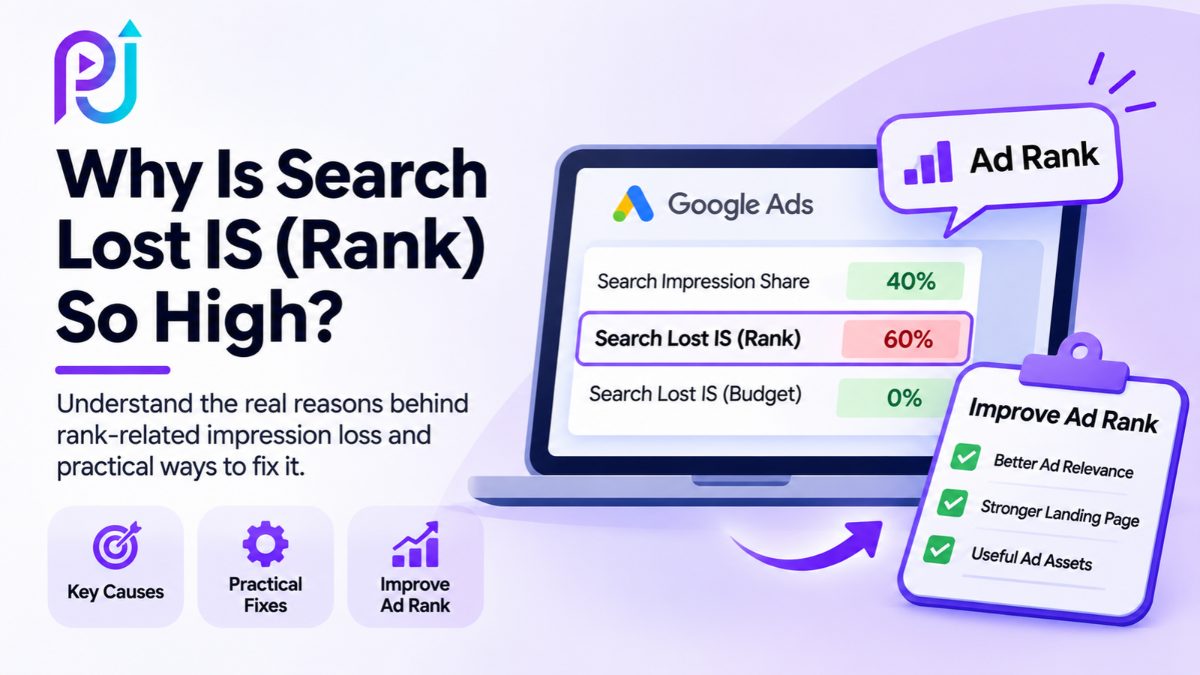
You open your Google Ads account and notice something confusing.
Your campaign is generating conversions. Your click-through rate looks healthy, and your keywords have good Quality Scores.
But one metric tells a different story.
Search Lost IS (rank): 58%.
That means Google estimates your ads missed a large share of eligible search impressions because their Ad Rank was not high enough.
The confusing part is that your campaign might not even be spending its full daily budget.
So why isn't Google showing your ads more often?
Should you increase bids, improve Quality Score, change your bidding strategy, or leave the campaign alone?
A high Search Lost IS Rank can be caused by weak auction-time ad quality, restrictive bidding targets, stronger competitors, or the types of searches your ads qualify for.
And while improving this metric can increase visibility, it does not guarantee more profitable conversions.
The first thing to understand is how your Google Ads Bidding Strategy affects auction participation. For campaigns using Target CPA or Target ROAS, the system may not bid aggressively enough to win every eligible auction while pursuing your chosen goal.
In this guide, I'll explain what Search Lost IS (rank) means, why the percentage can remain high even with good campaign performance, and how to identify the changes worth making.
What Is Search Lost IS (Rank) in Google Ads?
Search Lost IS (rank) measures the estimated percentage of eligible Search Network impressions your advertisements missed because of insufficient Ad Rank.
In simple terms, your ads were eligible for additional search visibility, but their Ad Rank was not sufficient for those opportunities.
Imagine Google estimates that your campaign could have received 10,000 impressions during a reporting period.
Your ads receive 4,000 impressions.
The remaining 6,000 impressions are missed opportunities.
If Google attributes 5,000 of those missed impressions to Ad Rank, your Search Lost IS (rank) would be 50%.
This does not mean you lost 5,000 conversions or that those impressions would have produced profitable clicks.
It means your campaign missed estimated search visibility because of its ranking competitiveness.
Search Lost IS (Rank) Formula
Search Lost IS (Rank) = (Estimated Impressions Lost Due to Rank ÷ Estimated Eligible Impressions) × 100
The figures used by Google are estimates. You do not receive a complete list of every individual auction that contributed to the calculation.
Search Impression Share vs Lost IS Rank vs Lost IS Budget
These three metrics help explain your campaign's search visibility.
| Metric | Meaning |
|---|---|
| Search Impression Share | Percentage of eligible impressions your ads received |
| Search Lost IS (rank) | Estimated impressions missed because of insufficient Ad Rank |
| Search Lost IS (budget) | Estimated impressions missed because of insufficient campaign budget |
Consider this hypothetical example:
| Metric | Value |
|---|---|
| Eligible Impressions | 10,000 |
| Actual Impressions | 4,000 |
| Search Impression Share | 40% |
| Search Lost IS (rank) | 45% |
| Search Lost IS (budget) | 15% |
Here, the campaign receives 40% of its estimated eligible impressions.
Google attributes a greater share of the missing visibility to Ad Rank than to budget.
Increasing the budget alone would not directly solve the rank-related constraint.
However, improving Ad Rank may allow the campaign to win more auctions, which can increase spending and potentially expose a budget constraint later.
This is why impression share metrics should be reviewed together.
How to Find Search Lost IS (Rank) in Google Ads
You can add this metric to your Google Ads reporting table.
Step 1: Open Google Ads
Sign in and select the account you want to review.
Step 2: Open Campaigns
Go to the campaign reporting table and select the relevant Search campaign.
Step 3: Modify Columns
Click the Columns icon and choose Modify Columns.
Step 4: Open Competitive Metrics
Find the impression share metrics.
Add:
- Search Impr. Share
- Search Lost IS (rank)
- Search Lost IS (budget)
- Search Top IS
- Search Abs. Top IS
Step 5: Apply the Columns
Save your view and compare the relevant reporting periods.
You can also examine rank-related impression share at more detailed levels where the metric is supported.
Note that budget-loss reporting has different availability limits from rank-loss reporting.
How Does Google Ads Ad Rank Work?
Ad Rank determines whether an advertisement is eligible to appear and where it can appear in a particular Google Ads auction.
Google recalculates Ad Rank for individual auctions.
It considers factors including:
- Bid amount: The bid entered manually or determined by the bidding system.
- Ad and landing page quality: The relevance and expected usefulness of the advertisement and destination page.
- Ad Rank thresholds: Minimum requirements for an ad to appear in a particular position.
- Auction competitiveness: The strength of competing advertisers in the auction.
- Search context: Factors such as location, device, search terms, and time.
- Expected asset impact: How useful and effective relevant ad assets are expected to be.
Google explains these factors in its official Ad Rank documentation.
The key detail is that Ad Rank can change from one auction to another.
A keyword might perform well for one search but be less competitive for another, even within the same campaign.
10 Reasons Your Search Lost IS (Rank) Is High
| Cause | What to Investigate | Possible Action |
|---|---|---|
| Restrictive Target CPA | Bid target versus actual CPA | Review target flexibility |
| Low Bids | Bid levels and campaign objectives | Test appropriate bid changes |
| Weak Ad Relevance | Keyword and ad alignment | Improve ad messaging |
| Poor Landing Page Experience | Page relevance and usability | Improve destination page |
| Low Expected CTR | Quality Score diagnostics | Strengthen ad relevance |
| Stronger Competition | Auction Insights | Prioritize valuable auctions |
| Weak Ad Assets | Relevant assets and eligibility | Add useful assets |
| Broad Keyword Coverage | Search terms and intent | Refine keyword targeting |
| Restrictive Target ROAS | ROAS target and conversion value | Review value-based bidding |
| Changing Auction Conditions | Device, location, time and demand | Analyze traffic segments |
Let's examine each cause.
1. Your Target CPA Is Too Restrictive
This is one of the first settings to investigate when a campaign has strong conversions but high Search Lost IS (rank).
Target CPA tells Google Ads to pursue conversions around your chosen average cost per acquisition.
For example, imagine your campaign has a Target CPA of $20.
Some auctions may require bids that the system does not consider suitable for achieving that target.
Your campaign can therefore miss impressions due to Ad Rank, even with money left in its daily budget.
This is similar to the issue described in the Google Ads community discussion you shared, where a campaign had good CTR, strong conversion performance, and high rank-related impression loss.
How to Fix It
Review your actual CPA and target CPA.
Check whether the target is realistic for your market and conversion goals.
If the campaign is profitable and you want more volume, consider testing a less restrictive target.
Monitor conversion volume, actual CPA, and impression share after the change.
Do not raise Target CPA simply to reduce the rank-loss percentage. The additional conversions must justify the cost.
2. Your Bids Are Not Competitive Enough
Your bid is one of the factors Google uses when calculating Ad Rank.
If your bid is insufficient relative to the auction conditions, your advertisement may not qualify for a position.
This is especially relevant for campaigns using Manual CPC or bidding strategies with applicable bid limits.
How to Fix It
Identify which campaigns and keywords have high rank-related impression loss.
Review their conversion rates, costs, and business value.
Where bid controls are available, consider carefully testing higher bids on profitable keywords.
Do not raise bids across an entire campaign without identifying where additional visibility is valuable.
A higher bid may improve auction competitiveness, but it can also increase CPC and acquisition costs.
3. Your Ads Do Not Match Search Intent
Ad relevance is an important part of auction-time ad quality.
Imagine someone searches for:
"Emergency AC Repair"
But your advertisement says:
"Professional Home Improvement Services"
The message is broad and does not clearly match what the customer wants.
A competitor whose ad explains emergency AC repair may offer a more relevant search experience.
How to Fix It
Review the keywords grouped within each ad group.
Check whether they represent similar search intent.
Write headlines and descriptions that reflect the service or product people are searching for.
For example, an ad group focused on emergency AC repair could include messages about emergency repair availability, service areas, and booking options, provided those claims are accurate.
Avoid creating separate campaigns or landing pages for every minor keyword variation.
Group closely related terms when they serve the same customer need.
4. Your Landing Page Experience Is Weak
Landing page experience can influence auction-time ad quality.
A page may be technically accessible but still provide a poor experience for the searcher.
Imagine your advertisement promotes commercial cleaning.
The visitor clicks and reaches a general homepage that gives little information about commercial cleaning.
The page may not meet the expectations created by the ad.
How to Fix It
Match the page's main headline to the advertised service.
Explain the offer and provide relevant details.
Make the website mobile-friendly.
Check page loading, navigation, and form functionality.
Keep the conversion action easy to find.
You can review common Landing Page Mistakes that affect the experience users have after clicking advertisements.
Remember that landing page conversion rate and Ad Rank are different measurements. Improving user experience can help both, but an increase in conversions does not guarantee a specific impression-share change.
5. Your Expected Click-Through Rate Is Below Average
Google uses expected CTR as one of its ad quality signals.
Expected CTR estimates how likely an advertisement is to receive a click when it appears for a search.
It is different from the actual CTR shown in your campaign reports.
You may have a healthy actual CTR but still find that an important keyword has a Below Average expected CTR diagnostic.
How to Fix It
Open your keyword table.
Add these Quality Score diagnostic columns:
- Expected CTR
- Ad Relevance
- Landing Page Experience
Review keywords showing Below Average ratings.
Improve unclear headlines, outdated offers, and weak connections between keyword intent and ad content.
Do not optimize the displayed 1–10 Quality Score as if it were a direct auction input.
Google confirms that Quality Score is a diagnostic measure, while auction-time quality signals contribute to Ad Rank.
6. Your Competitors Have Become More Competitive
Google Ads auctions change as advertisers enter, leave, or adjust their campaigns.
A new competitor may advertise for your most important keywords.
An existing competitor may improve its ads, landing pages, or bidding.
As competition changes, your campaign may miss more eligible impressions due to Ad Rank.
How to Fix It
Open Auction Insights for the affected Search campaign.
Compare your current period with the previous period.
Review competitor impression share, overlap rate, and position above rate.
Look for meaningful changes in competitive visibility.
Auction Insights does not reveal your competitors' actual bids or budgets, so avoid treating it as proof of exactly how much they increased spending.
If competition becomes stronger, prioritize your most valuable search terms rather than trying to win every auction.
7. Your Advertisements Are Missing Useful Ad Assets
Ad assets provide extra information alongside eligible advertisements.
Examples include sitelinks, callouts, structured snippets, call assets, location assets, and price or promotion assets.
Google considers the expected impact of assets and ad formats when calculating Ad Rank.
How to Fix It
Review which assets are available and relevant to your business.
For a local service company, useful assets may include:
- Sitelinks to important services
- Callouts describing genuine benefits
- Structured snippets listing service categories
- Location assets for eligible business locations
- Call assets when phone inquiries matter
Use accurate and relevant information.
Adding assets does not guarantee that every asset will appear or that rank loss will decrease.
Assets must be eligible, and Google decides when to display them.
8. Your Keywords Match Too Many Different Searches
Broad keyword coverage can introduce your campaign to a wider range of searches.
Some searches may be highly relevant, while others are less closely connected to the service being advertised.
The auction conditions can differ across those searches.
As a result, your ad may be competitive for some queries but not others.
How to Fix It
Open your Search Terms Report.
Identify which searches generate clicks, conversions, and qualified customers.
Review expensive or irrelevant queries.
Use negative keywords where the search intent is clearly unsuitable.
However, adding too many negative keywords can reduce useful traffic.
A well-designed exclusion strategy should protect relevance without blocking valuable searches.
For more detail, see Stop Wasting Google Ads Budget.
Keep in mind that restricting keyword eligibility can change the impression-share denominator. A better percentage after narrowing targeting does not automatically mean the campaign gained additional impressions.
9. Your Target ROAS Is Too Restrictive
Target ROAS is designed to pursue conversion value relative to advertising spend.
For example, a Target ROAS of 500% represents a goal of generating $5 in conversion value for every $1 spent.
A highly restrictive target can limit how aggressively the system bids in certain auctions.
If the system expects an auction to produce insufficient conversion value relative to the target, it may not bid enough to win that impression.
How to Fix It
Review your actual ROAS, target ROAS, and conversion values.
Check whether purchase revenue or lead values are tracked correctly.
Evaluate whether the target is achievable based on recent performance.
If you want greater volume and can accept a lower ROAS, consider a controlled test with a less restrictive target.
Monitor incremental conversion value and profit rather than impression share alone.
10. Auction Conditions Change Across Devices, Locations, and Times
Ad Rank is calculated for each auction, not assigned as one permanent value to every keyword.
A campaign may compete effectively for searches in one city and struggle in another.
The same keyword can also face different auction conditions on desktop and mobile.
Time of day, search wording, and competing advertisements can influence the result.
How to Fix It
Segment performance by device, location, and time.
Compare conversion results with visibility metrics where available.
Identify the segments that generate valuable customers.
Review your targeting and bidding settings for those segments.
Avoid excluding locations or devices based on high rank loss alone.
A segment may have lower visibility but produce profitable customers from the impressions it wins.
Why Search Lost IS (Rank) Is High Even With a 10/10 Quality Score
This is one of the most important misunderstandings in Google Ads.
A keyword can have a 10/10 Quality Score and still lose impressions because of Ad Rank.
Quality Score summarizes historical diagnostic information about expected CTR, ad relevance, and landing page experience.
It is not the actual score Google uses to rank your advertisement in each auction.
Auction-time Ad Rank also considers bids, thresholds, competition, search context, and expected asset impact.
For example, your keyword may have excellent relevance and landing page experience.
However, your Target CPA strategy may bid conservatively for certain auctions.
Those auctions may be lost even though the keyword's Quality Score is strong.
A 10/10 Quality Score does not guarantee high impression share or top placement.
The correct response is to examine your bidding objectives and auction competitiveness alongside quality diagnostics.
Why Is Search Lost IS (Rank) High When Your Budget Is Not Fully Spent?
Imagine the following hypothetical campaign:
| Metric | Value |
|---|---|
| Daily Budget | $100 |
| Average Daily Spend | $60 |
| Search Impression Share | 35% |
| Search Lost IS (rank) | 65% |
| Search Lost IS (budget) | 0% |
| Bidding Strategy | Target CPA |
The campaign is not using its full budget, but it is missing substantial search visibility.
Increasing the daily budget alone is unlikely to resolve the Ad Rank constraint.
The problem may involve restrictive bidding, insufficient auction-time competitiveness, or other quality and eligibility factors.
If the campaign uses conversion-focused Smart Bidding, the system may choose bids that do not win some eligible auctions while pursuing its conversion objective.
However, the rank-loss metric alone cannot tell you exactly how the algorithm assessed each auction.
Before making changes, check whether the campaign is producing leads or sales at a profitable cost.
If it is, the missed impressions may not justify higher spending.
What Is a Good Search Lost IS (Rank) Percentage?
There is no universal percentage that Google recommends for every advertiser.
An acceptable result depends on competition, budget, keyword intent, profit margins, and campaign objectives.
For example, a brand campaign may have different visibility goals from a non-brand lead generation campaign.
A company targeting expensive legal keywords may choose to miss some auctions rather than pay more than its leads are worth.
Instead of trying to reach 0% rank loss, ask:
- Is the campaign producing profitable conversions?
- Are important keywords losing valuable visibility?
- Is Search Impression Share declining over time?
- Are competitors becoming more visible?
- Can the business afford a higher cost per acquisition?
- Would additional impressions create useful demand?
A high percentage deserves investigation, but there is no guarantee that reducing it will improve profitability.
How to Reduce Search Lost IS (Rank) Without Wasting Budget
A useful troubleshooting process starts with the factors you can control.
Step 1: Compare Rank Loss and Budget Loss
Determine which constraint accounts for more of the missing visibility.
Step 2: Review Conversion Performance
Check cost per lead, purchases, revenue, and return on ad spend.
Step 3: Inspect Your Bidding Strategy
Review Target CPA, Target ROAS, Manual CPC settings, and any applicable bid limits.
Step 4: Check Keyword Quality Diagnostics
Review expected CTR, ad relevance, and landing page experience.
Step 5: Improve Relevant Ads and Landing Pages
Focus on the user experience and search intent.
Step 6: Review Auction Insights
Identify changes in competitor visibility.
Step 7: Add Useful Ad Assets
Make sure your advertisements provide information relevant to the business.
Step 8: Evaluate Search Terms
Identify irrelevant or poor-value traffic.
Step 9: Make One Significant Change at a Time
Document your baseline so you can understand what caused the results.
Step 10: Compare Performance After the Change
Measure impression share alongside conversion volume and acquisition cost.
For a broader campaign review, my guide to Google Ads Audit Warning Signs explains other issues worth checking before making major account changes.
Should You Increase Bids to Fix Lost Impression Share Due to Rank?
Increasing bids can improve Ad Rank competitiveness, but it is not always the best first action.
If your ads have poor relevance or weak landing pages, improving those areas may be more useful.
If your quality signals are strong and your bids are too restrictive, a controlled bid increase may help recover valuable visibility.
The decision should depend on the economics of your campaign.
For example, suppose your business generates qualified leads at $40 each and can profitably afford up to $60.
You may have room to test more competitive bidding.
But if your current CPA is already $75, increasing bids to win more impressions could make the campaign less efficient.
The key is to evaluate whether additional auctions can produce profitable customers.
High Search Lost IS (Rank) but Good Conversions: Should You Be Worried?
Not necessarily.
Imagine a campaign has the following results:
| Metric | Value |
|---|---|
| Search Impression Share | 40% |
| Search Lost IS (rank) | 60% |
| Monthly Spend | $1,000 |
| Conversions | 40 |
| Cost per Conversion | $25 |
Now imagine the business can profitably acquire customers at that cost.
The campaign is performing well despite missing some eligible impressions.
Reducing rank loss may increase exposure, but those additional impressions could come from more expensive or less valuable auctions.
The campaign might gain impressions without improving cost per acquisition.
For businesses that already receive sufficient traffic but struggle to generate leads, improving the Landing Page Conversion Rate can be a better use of resources than pursuing more impressions.
Impression share is a visibility measure.
Profitability is a business outcome.
The two should be analyzed together.
Common Mistakes Advertisers Make With Lost Impression Share
Mistake 1: Increasing daily budget to fix high rank loss.
More budget does not directly improve Ad Rank. First identify whether the campaign is actually budget-constrained.
Mistake 2: Assuming 10/10 Quality Score means every auction should be won.
Quality Score is diagnostic. Auction-time Ad Rank includes more factors.
Mistake 3: Raising Target CPA without checking profitability.
A higher target may permit greater bidding flexibility but can also increase acquisition costs.
Mistake 4: Treating all missed impressions as lost conversions.
Eligible impressions are not guaranteed clicks or customers.
Mistake 5: Rebuilding campaign structure without a clear reason.
Simply moving keywords into more ad groups or campaigns does not directly improve ad quality.
Mistake 6: Making several bidding changes in a short period.
This makes it difficult to identify which adjustment affected performance.
Mistake 7: Ignoring conversion tracking quality.
A campaign that counts unqualified actions as conversions may optimize toward the wrong outcomes.
If your ads are receiving clicks but generating little business value, review Google Ads Not Converting before pursuing additional impressions.
Search Lost IS Rank: Google Ads Audit Checklist
| Audit Area | What to Check | Priority |
|---|---|---|
| Search Impression Share | Current share and previous trend | High |
| Search Lost IS (rank) | Scale of rank-related loss | High |
| Search Lost IS (budget) | Whether budget limits visibility | High |
| Bidding Strategy | Target CPA, ROAS, and bid controls | High |
| Conversion Tracking | Accurate leads and purchases | High |
| Ad Relevance | Match between keywords and ads | High |
| Expected CTR | Keyword-level quality diagnostics | Medium |
| Landing Page | Relevance, usability, and speed | High |
| Auction Insights | Competitor visibility changes | Medium |
| Ad Assets | Relevance and eligibility | Medium |
| Search Terms | Irrelevant or low-value queries | High |
| Profitability | CPA, ROAS, and lead quality | High |
Use this checklist to identify the most meaningful constraint rather than adjusting every campaign setting.
About Prem Jasuja
Prem Jasuja is a freelance digital marketing professional specializing in Google Ads, Meta Ads, SEO, Google Analytics 4, Google Tag Manager, conversion tracking, and landing page optimization.
His work includes reviewing bidding strategies, search terms, conversion performance, campaign structure, and advertising budgets to help businesses make better marketing decisions.
He focuses on improving lead quality, sales performance, and the reliability of campaign measurement.
Final Thoughts
High Search Lost IS Rank means your Google Ads campaign is missing estimated eligible search impressions because its Ad Rank is insufficient.
But that does not automatically mean your advertisements are poor or your campaign is failing.
Even campaigns with strong CTR, excellent Quality Scores, and profitable conversions can have substantial rank-related impression loss.
The cause may involve restrictive bidding targets, auction competition, search context, or ad and landing page quality.
Start by checking Search Impression Share, Search Lost IS (rank), Search Lost IS (budget), bidding settings, and actual conversion performance.
Improve relevance where needed, review competitive pressure, and adjust bids only when the business value supports it.
The goal is not to win every Google Ads auction. It is to win the auctions that help your business generate profitable customers.
Frequently Asked Questions
What Does Search Lost IS (Rank) Mean in Google Ads?
Search Lost IS (rank) is the estimated percentage of eligible Search Network impressions your ads missed because their Ad Rank was insufficient. It helps identify visibility lost through auction competitiveness rather than budget constraints.
Why Is My Search Lost IS (Rank) So High?
A high percentage can result from restrictive bids or bidding targets, stronger competition, weak ad relevance, poor landing page experience, or other auction-time Ad Rank factors. Review your bidding strategy, quality diagnostics, and Auction Insights.
Can Search Lost IS (Rank) Be High With a 10/10 Quality Score?
Yes. Quality Score is a diagnostic metric, not the direct input Google uses to rank advertisements in each auction. Ad Rank also considers bids, thresholds, competition, search context, and asset impact.
What Is the Difference Between Search Lost IS (Rank) and Budget?
Search Lost IS (rank) estimates visibility missed because of insufficient Ad Rank. Search Lost IS (budget) estimates visibility missed because the campaign budget was inadequate. The causes and potential fixes are different.
Will Increasing My Google Ads Budget Reduce Search Lost IS (Rank)?
Not directly. Increasing the budget addresses funding constraints, while rank loss is associated with Ad Rank. Review bidding and ad quality before increasing spending to solve a rank-related problem.
Does Target CPA Cause High Search Lost IS (Rank)?
It can contribute. A restrictive Target CPA may lead the bidding system to place bids that are insufficient to win some auctions. Review actual CPA, target settings, and conversion performance before adjusting the target.
How Can I Improve Search Lost IS (Rank) Without Raising Bids?
Review ad relevance, landing page experience, keyword intent, and useful ad assets. Improving these areas may help auction-time competitiveness, although no single change guarantees a particular impression-share result.
What Is a Good Search Lost IS (Rank) Percentage?
Google does not provide one universal ideal percentage. An acceptable level depends on your industry, competition, budget, campaign objectives, and profitability. Evaluate rank loss alongside conversions and acquisition costs.
Why Is Search Lost IS (Rank) High When My Campaign Has Unused Budget?
Unused budget and high rank loss can occur together when bids or auction-time quality are insufficient to win additional impressions. With automated bidding, the campaign's conversion objectives may also influence bidding decisions.
Should I Try to Reduce Search Lost IS (Rank) to Zero?
Not necessarily. Winning more auctions may require higher bids and could increase acquisition costs. Focus on recovering valuable impressions while maintaining profitable conversion performance rather than treating zero rank loss as the ultimate goal.