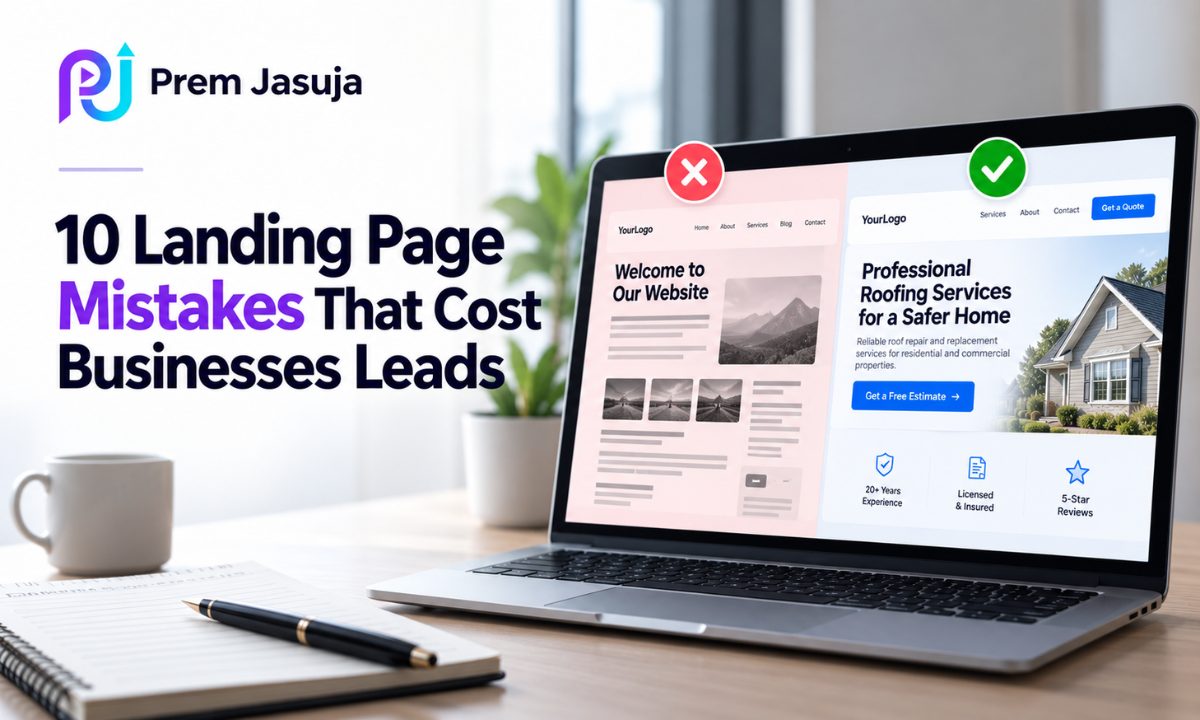
Your Google Ads campaign is generating clicks. Your Meta Ads are reaching potential customers. People are visiting your website, but very few are filling out forms, booking appointments, or making purchases.
You might assume your advertisements are the problem.
However, the real issue could be your landing page.
A landing page is where visitors decide whether your business offers what they need and whether taking the next step is worthwhile.
If the page is slow, confusing, difficult to navigate, or disconnected from the advertisement, potential customers may leave without converting.
These landing page mistakes can become especially expensive when you pay to attract every visitor.
The solution is not always a complete website redesign. Sometimes, improving your headline, simplifying a form, or correcting conversion tracking can make a meaningful difference.
The most effective landing pages clearly explain the offer, establish trust, and make it easy for relevant visitors to take action.
In this guide, we will explore ten common landing page mistakes that cost businesses leads, how to identify them, and practical fixes that can help improve conversion performance.
What Are Landing Page Mistakes?
Landing page mistakes are design, content, technical, or usability problems that prevent visitors from completing an intended action.
That action might be submitting a contact form, requesting a quote, scheduling an appointment, registering for a trial, or purchasing a product.
For example, imagine a roofing business running Google Ads for emergency roof repairs.
Someone searches for emergency roofing services, clicks the advertisement, and arrives at a page discussing every construction service the company provides.
The visitor cannot immediately find emergency repair information or a clear contact option.
Even though the advertising attracted a relevant person, the page made it difficult to proceed.
This is a landing page conversion problem.
The most important question is not whether a page looks attractive.
It is whether the page gives the intended visitor enough information, confidence, and convenience to take the next step.
Why Landing Page Mistakes Cost Businesses Money
Landing page performance directly affects the value businesses receive from their advertising traffic.
Consider this hypothetical example.
A business spends $1,500 on advertising and receives 600 landing page visitors.
Its landing page converts 2% of those visitors into leads.
That generates 12 leads at a cost of $125 per lead.
Now imagine the same page converts 4% of visitors.
The business generates 24 leads, bringing its advertising cost per lead to $62.50.
| Metric | Before | Illustrative After |
|---|---|---|
| Advertising Spend | $1,500 | $1,500 |
| Landing Page Visitors | 600 | 600 |
| Conversion Rate | 2% | 4% |
| Leads | 12 | 24 |
| Cost Per Lead | $125 | $62.50 |
These figures illustrate the relationship between conversion rate and cost per lead. They are not guaranteed results.
Improving conversion rate can help businesses generate more inquiries from existing traffic.
However, lead quality also matters.
A page that generates more form submissions but fewer qualified customers may not represent a genuine improvement.
This is why landing page optimization should focus on meaningful business outcomes.
10 Common Landing Page Mistakes and How to Fix Them
1. Your Landing Page Headline Does Not Explain the Offer
Your headline is one of the first things visitors notice.
If it is vague, visitors may struggle to understand whether your business can help them.
Businesses sometimes use headlines such as:
"Transforming Your Future"
"Solutions That Matter"
"Experience Excellence"
These statements may sound professional, but they do not explain the actual product or service.
Imagine someone clicking an advertisement for Power BI dashboard development.
A generic headline about business growth does not immediately confirm that the visitor has reached a relevant page.
How to fix it
Use a headline that clearly communicates your service, intended audience, or main benefit.
For example:
Weak: "Unlock Your Business Potential"
Better: "Power BI Dashboard Development for Businesses"
The second headline communicates the service and intended customer more directly.
Support it with a short explanation of what your business provides.
Keep the message consistent with the advertisement.
If the campaign promotes a specific offer, make that offer easy to identify immediately.
Key takeaway: Clarity should come before clever wording.
2. Your Landing Page Does Not Match the Advertisement
Poor message match is one of the most costly landing page mistakes in paid advertising.
When someone clicks an advertisement, they expect the destination to provide information related to that advertisement.
If the page presents a different service, offer, or message, visitors may lose interest.
For example, imagine a customer searching for "car scratch repair in Ottawa."
The advertisement promotes professional scratch removal services.
However, the visitor lands on a general auto detailing homepage.
The page mainly discusses ceramic coatings, interior detailing, and car washing.
The visitor must now search for the service they originally wanted.
That creates unnecessary friction.
How to fix it
Send visitors to a page closely aligned with their search intent and advertisement.
Match the main headline, service details, offer, and CTA.
For campaigns targeting specific services, consider using dedicated landing pages or relevant existing service pages.
A separate page is not always necessary.
If your current service page clearly addresses the advertisement and provides a useful conversion experience, improving that page may be the better decision.
For Google Ads, landing page relevance is also part of the landing page experience assessment associated with Quality Score.
Explore Google Ads Management for help aligning advertising campaigns with customer intent.
3. Your Landing Page Has Too Many Distractions
A visually attractive landing page is not automatically a high-converting landing page.
Some businesses add multiple videos, animations, popups, promotional banners, and competing buttons.
Each element may look useful individually.
Together, they can make the page difficult to understand.
Imagine a visitor arriving to request a consultation.
The page immediately displays a newsletter popup, a promotional banner, a chatbot, and several unrelated offers.
Instead of guiding visitors toward the intended action, the page creates competing choices.
How to fix it
Establish one clear primary conversion objective.
Organize the content around that goal.
Use headings, supporting text, relevant imagery, and whitespace to create a readable visual hierarchy.
Remove elements that do not help visitors understand the offer or make a decision.
Navigation does not always need to disappear completely.
For simple campaign landing pages, limited navigation may reduce distractions.
For B2B services, expensive purchases, or complex products, visitors may need access to additional information before converting.
The goal is to remove unnecessary friction without hiding important content.
Key takeaway: Keep the experience focused, not artificially restrictive.
4. Your Call to Action Is Weak or Difficult to Find
A call to action tells visitors what they should do next.
If it is unclear or hidden, people may leave despite being interested in your service.
Generic buttons such as "Click Here" or "Submit" often provide little context.
Visitors should understand what happens when they click.
For example, a local construction company might use:
"Request a Renovation Estimate"
A SaaS company might use:
"Schedule a Product Demo"
An eCommerce business might use:
"Add to Cart"
These examples communicate the expected action.
How to fix it
Choose CTA wording that matches the visitor's intent.
Make the main button visually noticeable without using unnecessarily aggressive design.
Place the primary action near the main offer.
For longer pages, repeat the CTA at natural decision points, such as after service details, testimonials, or pricing information.
Check that buttons work correctly on mobile devices.
Avoid using different primary CTAs that lead to unrelated outcomes.
For example, asking visitors to download a guide, register for a webinar, and request a sales call simultaneously may create confusion.
Supporting actions can remain available when they help the customer journey.
However, the intended primary conversion should be clear.
5. Your Contact Form Is Too Complicated
Forms are a critical part of many lead-generation landing pages.
They are also a common source of conversion friction.
Imagine someone requesting a quote for a local service.
The form asks for their name, phone number, email, company, job title, budget, timeline, complete address, and several additional details.
Some of that information may be useful to the business.
But does the business need all of it before the first conversation?
Not always.
How to fix it
Ask for the information needed to take the next step.
For a straightforward local service inquiry, this may include a name, contact method, service requirement, and brief message.
For a high-value B2B service, additional qualification questions may be reasonable.
For example, company size, project scope, or budget may help determine whether an inquiry is a suitable opportunity.
The objective is not to make every form as short as possible.
It is to balance ease of completion with lead quality.
Review form field labels, validation messages, autofill support, and mobile usability.
Test both successful and unsuccessful submissions.
If a form displays an error, visitors should understand what needs correcting.
Also explain what happens after submission.
For example, tell visitors whether they will receive a callback, email, or booking confirmation.
Key takeaway: Reduce unnecessary fields without removing information essential for qualification.
6. Your Landing Page Loads Slowly or Performs Poorly on Mobile
A slow landing page can make visitors abandon the experience before they see your offer.
This problem is especially important for mobile advertising traffic.
Large images, excessive scripts, heavy videos, complicated page builders, and poorly configured website resources can affect loading performance.
However, speed is not the only issue.
A landing page may load reasonably quickly but still be difficult to use.
Small text, overlapping elements, complicated menus, and inaccessible buttons can prevent visitors from converting.
How to fix it
Test your landing page on actual mobile devices.
Make sure important information is readable without zooming.
Use suitably sized buttons and clear form fields.
Avoid elements that cover the main content.
Compress oversized images and review unnecessary scripts.
Use Google PageSpeed Insights to identify technical issues.
Pay attention to the Core Web Vitals metrics:
| Metric | What It Measures | Good Threshold |
|---|---|---|
| Largest Contentful Paint (LCP) | Main content loading | 2.5 seconds or less |
| Interaction to Next Paint (INP) | Responsiveness | 200 milliseconds or less |
| Cumulative Layout Shift (CLS) | Visual stability | 0.1 or less |
These thresholds describe web performance guidance, not guaranteed conversion rates.
A landing page should feel fast, stable, and usable.
Prioritize fixes that improve the real visitor experience rather than focusing only on achieving a perfect performance score.
7. Your Landing Page Does Not Build Enough Trust
Visitors may hesitate before submitting personal information or purchasing from an unfamiliar business.
They want to know whether your company is credible and capable of delivering the advertised service.
A landing page containing only promotional claims may not provide enough reassurance.
Statements such as "Best Service Provider" or "Trusted Industry Leader" carry limited value without supporting evidence.
How to fix it
Include genuine trust signals relevant to your business.
Examples include customer testimonials, verified reviews, case studies, relevant certifications, actual project photographs, and clearly explained service processes.
An eCommerce business may benefit from transparent shipping policies, return information, and secure checkout details.
A local service company may show completed projects and authentic customer feedback.
A B2B company may provide relevant case studies and information about its implementation process.
Position trust information close to important decision points.
For example, a real testimonial near a consultation form can answer concerns before submission.
Avoid fabricated reviews, unsupported statistics, or client logos used without authorization.
Key takeaway: Credibility is strongest when visitors can verify the evidence.
8. Your Landing Page Uses Generic Content and Irrelevant Images
Landing page content should reflect the audience and its specific needs.
A business may offer several services, but visitors arriving from different campaigns are not necessarily searching for the same solution.
For example, a company offering Google Ads management, SEO, website development, and Meta Ads may use one general landing page for every campaign.
However, someone who clicked a Google Ads management advertisement may not want to read extensive information about unrelated services.
Generic content creates extra work for visitors.
Irrelevant imagery can also weaken credibility.
Large decorative graphics and generic stock photographs may add visual weight without helping people evaluate the offer.
How to fix it
Use messaging that matches the campaign's purpose.
Describe the relevant service, customer problem, and expected next step.
Where helpful, create service-specific landing pages.
Use authentic project images, product photographs, demonstrations, or appropriately authorized screenshots.
For software businesses, genuine product visuals can help visitors understand functionality.
For local service companies, photographs of completed work may be more informative than generic corporate imagery.
Avoid overcrowding the page with images that serve no clear purpose.
Visual content should support understanding, not compete with it.
Explore Landing Page Development Services for conversion-focused page design.
9. You Are Not Tracking Landing Page Conversions Correctly
One of the most serious landing page mistakes is making optimization decisions using incomplete or inaccurate tracking.
A business might receive genuine inquiries that are not recorded.
Alternatively, analytics may count actions that do not represent actual leads.
For example, imagine a visitor clicks a contact form's Submit button.
The form fails because a required field is missing.
If your conversion tracking records the button click rather than a successful submission, the advertising platform may count a conversion even though no lead was generated.
This can distort campaign performance.
How to fix it
Use Google Analytics 4, Google Tag Manager, and appropriate advertising conversion tracking tools to measure meaningful actions.
For lead generation, prioritize successful form submissions, confirmed bookings, or qualified calls where measurement supports them.
For eCommerce, track completed transactions and accurate purchase values.
Test your conversion events.
A failed form submission should not trigger a completed lead event.
A phone-number click should be distinguished from a verified connected call.
Also check for duplicate conversion events.
Compare analytics data with actual form records, CRM information, or order records.
Different platforms may report different numbers because of attribution and processing differences, so investigate discrepancies in context.
Accurate tracking helps you understand where landing page optimization is needed.
Learn more about Conversion Tracking Services.
10. You Never Test or Improve Your Landing Page
Many businesses create a landing page, launch advertising, and leave the page unchanged for months.
However, customer expectations, advertising messages, and product offers can evolve.
A landing page that performed well earlier may have room for improvement.
Without regular analysis, businesses may miss opportunities to reduce friction and improve conversion quality.
How to fix it
Start by establishing baseline performance.
Review the current conversion rate, number of leads, form completion rate, and customer acquisition costs.
Identify the most important obstacle.
For example, if visitors frequently begin a form but rarely finish, form usability may deserve investigation.
If mobile visitors convert at a substantially lower rate than desktop visitors, examine the mobile experience.
Create a clear testing hypothesis.
For example:
"Making the consultation CTA more specific may improve completed inquiries."
Test one meaningful change at a time when practical, while keeping other major variables consistent.
Use appropriate sample sizes and avoid declaring a winner based on a handful of conversions.
Document what you changed, what happened, and what you learned.
Not every test will produce an improvement.
The purpose is to replace assumptions with evidence.
How to Identify Which Landing Page Mistake Is Costing You the Most Leads
Not every problem deserves equal priority.
Use available data to identify where visitors encounter difficulties.
| What You Notice | What to Investigate |
|---|---|
| Visitors leave without engaging | Headline relevance, content, loading performance |
| High clicks but few leads | Message match, offer, landing page usability |
| Many form starts but few completions | Form length, errors, mobile usability |
| Mobile conversion rate is unusually low | Responsive layout, speed, CTA accessibility |
| Leads are recorded but not received | Conversion tracking and form functionality |
| Plenty of inquiries but few customers | Lead quality and qualification |
| Performance changes after a redesign | Tracking, page functionality, and content changes |
Avoid assuming every low conversion rate is caused by the landing page.
Traffic quality also matters.
If a campaign attracts users searching for unrelated products or information, redesigning the page may not fix the underlying problem.
Review Google Ads search terms, campaign targeting, and traffic sources alongside website performance.
How to Improve Landing Page Conversions Without Increasing Ad Spend
You do not always need more visitors to generate more leads.
Sometimes, improving the experience for existing visitors is a more efficient opportunity.
Start by reviewing the current landing page from the customer's perspective.
Does the headline explain the offer?
Does the page provide what the advertisement promised?
Is the next step obvious?
Can someone complete the form easily on a phone?
Does the page provide credible information about the business?
Once these fundamentals are addressed, focus on measurement and testing.
Prioritize changes based on their likely impact and the strength of the evidence.
Do not redesign every element simultaneously unless the page has a fundamental usability problem.
A structured approach makes it easier to understand which improvements contribute to results.
Landing Page Optimization Checklist
Before publishing or updating a landing page, review the following:
- The headline clearly explains the offer.
- Content matches the advertising message.
- The primary CTA is visible and understandable.
- Unnecessary distractions are removed.
- Form fields reflect genuine business requirements.
- Forms and buttons work on mobile devices.
- The page loads efficiently.
- The layout remains stable and readable.
- Images are relevant and professional.
- Real customer proof is available where appropriate.
- Privacy and contact information are accessible.
- Successful conversions are tracked accurately.
- Duplicate conversions have been checked.
- Lead quality is reviewed.
- Testing and optimization are part of the ongoing process.
This checklist provides a practical starting point, but the best improvements depend on your business model and customer journey.
Should You Use Your Homepage or a Dedicated Landing Page?
A dedicated landing page can be useful when a campaign promotes a particular offer, service, or audience.
For example, a Google Ads campaign advertising basement renovations may benefit from a page specifically discussing basement renovation services.
However, dedicated pages are not always required.
A relevant and well-designed service page may already meet the customer's needs.
For branded searches or complex purchases, visitors may also benefit from broader website information.
The decision should depend on how well the destination answers the visitor's questions and supports the intended conversion.
The best page is not automatically the shortest or most visually attractive one. It is the page that best supports the customer's decision.
When Should You Hire a Landing Page Specialist?
Some improvements can be handled through a website builder or content management system.
Others require more technical work.
Consider professional support when your landing page receives substantial traffic without generating enough leads, mobile usability problems persist, tracking is unreliable, or complex forms are difficult to implement.
A landing page specialist can review messaging, visual hierarchy, conversion paths, responsiveness, tracking, and testing opportunities.
The goal should be to identify actual conversion obstacles rather than redesign the website simply for appearance.
Why Work With Prem Jasuja for Landing Page Optimization?
Prem Jasuja is a freelance digital marketing professional experienced in Google Ads, Meta Ads, conversion tracking, and landing page development.
His work includes SaaS businesses, eCommerce stores, B2B companies, and local service providers.
Different businesses require different landing page strategies.
For local services, the focus may be clear service details, trustworthy customer proof, and accessible contact options.
For B2B companies, the page may need to explain a complex offering and qualify potential customers.
For eCommerce stores, product information, pricing, trust, and checkout usability become particularly important.
Prem's approach connects landing page experience with advertising intent and meaningful conversion measurement.
Explore Landing Page Development, Google Ads Management, or previous projects to learn more about the services and businesses supported.
Final Thoughts
Landing pages play an important role in turning website visitors into customers.
However, even a well-funded advertising campaign can struggle when the destination is confusing, slow, irrelevant, or difficult to use.
The most common landing page mistakes involve unclear messaging, poor advertisement alignment, unnecessary distractions, weak CTAs, complicated forms, mobile usability problems, missing trust signals, generic content, inaccurate tracking, and insufficient testing.
The good news is that many of these issues can be investigated without rebuilding the entire website.
Start by identifying the most significant obstacle.
Then make focused improvements and measure the results.
Remember that more form submissions do not always mean better performance.
Qualified leads, purchases, and customer acquisition costs are often more useful indicators of business value.
An effective landing page does more than attract attention. It helps the right visitor make a confident decision.
Need Help Improving Your Landing Page Conversions?
If your Google Ads or Meta Ads campaigns are attracting visitors but generating too few inquiries or sales, your landing page may need a closer review.
Prem Jasuja can help evaluate landing page relevance, conversion tracking, usability, and optimization opportunities.
Contact Prem Jasuja to discuss your landing page and lead-generation goals.
Frequently Asked Questions
What Are the Most Common Landing Page Mistakes?
Common landing page mistakes include unclear headlines, poor advertisement message match, cluttered designs, weak calls to action, complicated forms, slow loading, poor mobile usability, missing trust signals, inaccurate conversion tracking, and limited testing.
Why Is My Landing Page Getting Traffic but No Leads?
Your landing page may not match visitor intent, may have an unclear offer, or may make it difficult to complete the intended action. Also verify that tracking is working and that your traffic sources attract relevant potential customers.
How Can I Improve My Landing Page Conversion Rate?
Start by improving headline clarity, matching page content to advertisements, making CTAs more accessible, simplifying unnecessary form fields, improving mobile usability, and adding genuine trust signals. Test meaningful changes and evaluate conversion quality.
Does Landing Page Speed Affect Conversions?
Yes. Slow loading can create friction and cause visitors to leave before interacting with the page. Improve images, scripts, hosting, and loading performance while evaluating actual user experience on mobile and desktop.
Should Landing Pages Have Navigation Menus?
It depends on the campaign and customer journey. A focused paid landing page may benefit from simplified navigation, while complex services or expensive purchases may require access to additional information. Test whether navigation helps or distracts visitors.
How Many Form Fields Should a Landing Page Have?
There is no universal ideal number. Ask for the information necessary to respond to the inquiry or qualify the lead. Simple offers may need fewer fields, while complex B2B services may require additional details. Balance completion rate with lead quality.
Is a Dedicated Landing Page Better Than a Homepage?
A dedicated landing page can be more relevant for specific advertisements and offers. However, a suitable existing service page or homepage may also perform well when it clearly addresses visitor intent and provides an easy conversion process.
How Do I Track Landing Page Conversions?
Use appropriate measurement tools such as GA4, Google Tag Manager, and advertising conversion tags. Track confirmed actions such as successful form submissions, bookings, or purchases, and test events to avoid missing or duplicated conversions.
How Often Should I A/B Test a Landing Page?
Testing frequency depends on traffic, conversion volume, and business priorities. Run tests when you have a meaningful hypothesis and enough data to evaluate results. Avoid changing several major variables simultaneously without a clear testing plan.
Can Fixing Landing Page Mistakes Reduce Cost Per Lead?
Yes, improving the landing page conversion rate can reduce cost per lead when advertising costs and traffic remain comparable. However, measure qualified lead quality and customer acquisition outcomes alongside conversion volume to assess the real business impact.
_____________________________________________________________________