Imagine opening your Google Ads account and noticing something strange.
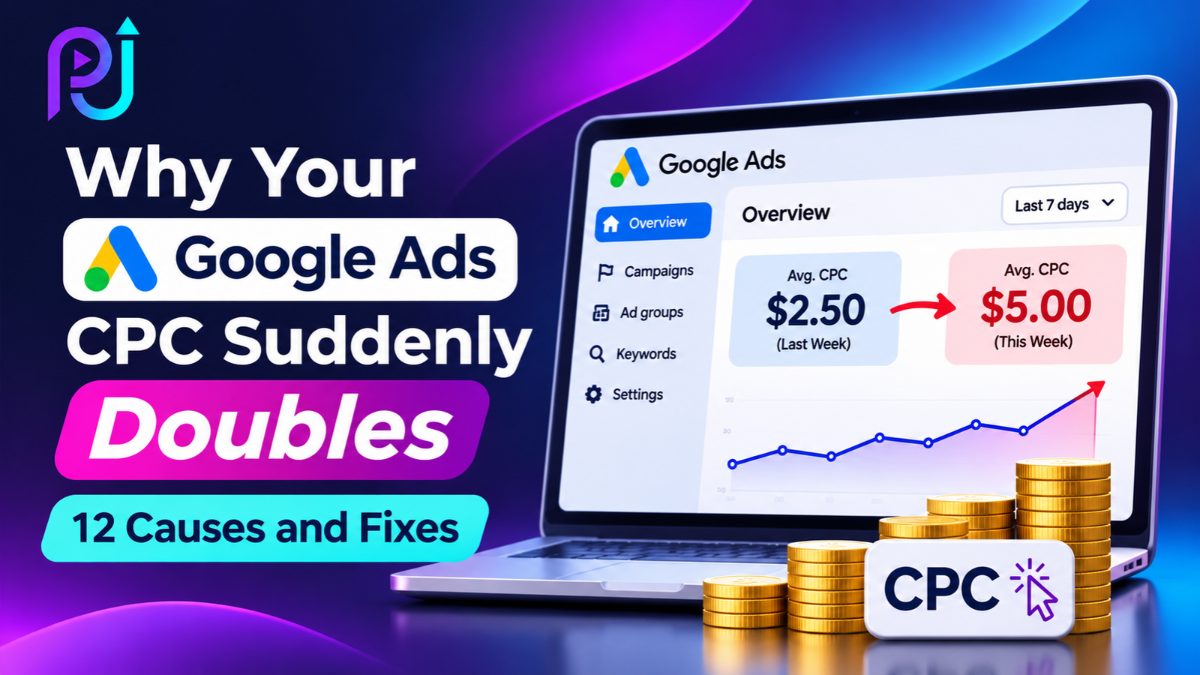
Last week, your average cost per click was $2.50. This week, it has increased to $5.
Your campaign is still running. Your keywords haven't changed, and your daily budget is the same.
Yet every click now costs twice as much.
Naturally, you start wondering what happened.
Did Google change something? Are your competitors bidding more? Is your campaign targeting more expensive searches?
A sudden Google Ads CPC Increase can happen for several reasons, and the cause isn't always obvious from the campaign overview.
Google Ads works through a live auction, which means the price you pay for a click can change even when you haven't made changes to your account.
Competition, bidding strategies, keyword matching, ad quality, and the types of searches entering your campaign can all influence your average CPC.
Understanding your Google Ads Bidding Strategy is a useful starting point because different bidding strategies can change which auctions your ads enter and how much you're willing to pay for valuable clicks.
In this guide, I'll explain why Google Ads CPC suddenly increases, how to identify the actual cause, and what you can do to control advertising costs without sacrificing profitable conversions.
What Is Cost Per Click in Google Ads?
Cost per click, or CPC, is the amount an advertiser pays when someone clicks an advertisement.
Google Ads reports average CPC by dividing the total cost of clicks by the number of clicks received.
Average CPC = Total Click Cost ÷ Total Clicks
For example:
| Metric | Previous Week | Current Week |
|---|---|---|
| Ad Spend | $500 | $500 |
| Clicks | 200 | 100 |
| Average CPC | $2.50 | $5.00 |
| CPC Change | — | +100% |
In this example, the advertiser spends the same amount of money but receives half as many clicks.
That can become a concern if the campaign also generates fewer leads or purchases.
However, a higher CPC is not automatically bad.
If the more expensive clicks generate better customers, the campaign may still produce strong results.
That's why CPC should be reviewed alongside conversion rate, cost per acquisition, revenue, and return on ad spend.
How Does Google Ads Determine Cost Per Click?
Google Ads uses an auction to decide which ads are eligible to appear, their placement, and how much advertisers pay.
The final cost depends on factors such as bidding, Ad Rank thresholds, auction-time ad quality, and the competition participating in that auction.
For example, imagine three businesses advertising plumbing services.
All three want their ads to appear when someone searches for "emergency plumber near me."
Each advertiser may have different bids, ads, landing pages, and campaign goals.
Google evaluates eligible ads and determines their ranking through the auction.
The actual CPC can change from one search to another because each auction has its own conditions.
This means your average CPC may increase when your ads begin participating in a more expensive mix of auctions.
12 Reasons Your Google Ads Cost Per Click Suddenly Doubles
A CPC increase can result from one issue or several changes occurring together.
| Possible Cause | What Happens | What to Check |
|---|---|---|
| Increased Competition | Advertisers compete more aggressively | Auction Insights |
| Bidding Strategy Changes | Bids change across auctions | Change History |
| Lower Ad Quality | Ads or landing pages become less relevant | Quality Score components |
| Broad Match Expansion | Campaign enters different searches | Search Terms Report |
| Seasonal Demand | Advertisers compete during busy periods | Historical performance |
| Budget Changes | Campaign reaches a different auction mix | Budget and CPC trends |
| Device Performance | More clicks come from expensive devices | Device segments |
| Location Targeting | Traffic shifts toward expensive areas | Location reports |
| Search Partners | Network traffic mix changes | Network segments |
| Conversion Tracking | Bidding receives different conversion signals | Conversion actions |
| Higher Position Targets | Campaign competes for greater visibility | Impression share metrics |
| Keyword Mix Changes | Expensive keywords receive more traffic | Keyword performance |
Let's examine each cause and the steps you can take to investigate it.
1. Increased Competition in Google Ads Auctions
One of the most common reasons CPC increases is stronger competition.
When more advertisers compete for the same searches, the auction becomes more competitive.
For example, imagine you advertise personal injury legal services.
Your average CPC remains stable for several weeks.
Then a new law firm starts advertising aggressively in your target area.
Existing competitors may also adjust their bidding strategies.
As the auction changes, your cost per click may increase even though your campaign settings remain unchanged.
How to Check It
Open Google Ads and review Auction Insights for the affected Search campaign.
Compare your current reporting period with an earlier period.
Look at:
- Impression share
- Overlap rate
- Position above rate
- Outranking share
- Top-of-page rate
- Absolute top-of-page rate
If a competitor begins appearing in more of your auctions or moves above your ads more often, that may indicate increased competitive pressure.
Remember that Auction Insights does not reveal competitors' exact bids or budgets.
How to Fix It
Focus on keywords that generate qualified leads or profitable sales.
Consider more specific commercial keywords where the business can compete effectively.
Improve ad relevance and landing page quality.
Avoid increasing every bid simply to compete for visibility.
The goal is to win valuable traffic, not every auction.
2. You Recently Changed Your Google Ads Bidding Strategy
A bidding strategy change can alter how your campaign participates in auctions.
For example, switching from Manual CPC to Maximize Conversions changes the way bids are determined.
With Manual CPC, advertisers set bids directly.
With Maximize Conversions, Google uses available signals to pursue conversions within the campaign's bidding settings.
This may result in higher bids for auctions the system predicts are more likely to convert.
As a result, average CPC may rise.
However, if conversion volume or quality improves enough, the higher CPC may be acceptable.
How to Check It
Open Google Ads Change History.
Review changes to:
- Bidding strategy
- Target CPA
- Target ROAS
- Maximum CPC limits
- Conversion goals
- Campaign budget
Compare the date of those changes with the date your CPC increased.
Check the bid strategy status and conversion results.
How to Fix It
Confirm that the bidding strategy matches your campaign objective.
If your goal is to generate qualified leads, review whether Google Ads is optimizing toward meaningful lead conversions.
Avoid switching strategies repeatedly in response to short-term CPC fluctuations.
Give significant changes enough time and data to evaluate their impact.
3. Your Ad Quality or Landing Page Experience Declined
Google considers auction-time ad quality when evaluating ads.
Factors include expected click-through rate, ad relevance, and landing page experience.
A decrease in these signals may make it harder for your ad to compete efficiently.
For example, imagine you advertise "commercial roofing services."
Your original landing page explains commercial roof repairs, inspections, and installation.
Later, you replace it with a generic homepage that discusses several unrelated services.
The new page may provide a weaker experience for someone searching for commercial roofing.
What About Quality Score?
Google Ads provides a keyword-level Quality Score from 1 to 10.
Its three components are:
- Expected CTR
- Ad relevance
- Landing page experience
Quality Score is a diagnostic tool. Google does not use the displayed 1–10 score as a direct auction input.
However, its components can help you identify problems with ad and landing page quality.
How to Fix It
Review your keyword-level Quality Score components.
Identify keywords with Below Average ad relevance or landing page experience.
Improve ad messaging so it matches the searcher's intent.
Send visitors to a page that clearly answers their search.
Review your Landing Page Mistakes to identify problems that may also affect conversions.
4. Broad Match Keywords Are Bringing More Expensive Search Terms
Broad match keywords can help advertisers reach relevant searches beyond the exact wording of their keywords.
However, different searches can have different competitive conditions.
For example, imagine your campaign targets:
digital marketing agency
With broad match, the campaign may become eligible for related searches that differ in wording and intent.
Some of those searches may be more competitive than the queries previously generating traffic.
If a larger share of clicks comes from expensive searches, your average CPC may increase.
How to Check It
Open the Search Terms Report.
Compare current search terms with the previous period.
Look for changes in:
- Search intent
- Click volume
- Cost
- Conversions
- Cost per conversion
- Keyword match types
Identify expensive searches that do not match your business offering.
How to Fix It
Add negative keywords for searches that are genuinely irrelevant.
Consider more specific keyword targeting when appropriate.
Do not automatically replace every broad match keyword with exact match.
Broad match can perform well when paired with suitable bidding and reliable conversion data.
Review actual results before restricting targeting.
5. Seasonal Demand Has Increased Auction Competition
Some industries experience predictable changes in advertising demand.
Examples include retail during major shopping events, accounting during tax season, and travel during popular holiday periods.
When more advertisers compete during these periods, CPC may increase.
For example, an ecommerce advertiser may experience higher CPC during Black Friday because more retailers are competing for purchase-focused searches.
This can happen even when campaign settings remain unchanged.
How to Check It
Compare the current period with the same period last year.
Review whether CPC increased during similar seasonal periods.
Use Auction Insights to understand changes in competitive visibility.
Check whether search demand and conversion performance have also changed.
How to Fix It
Plan advertising budgets around periods that generate profitable demand.
Focus on products and services with strong margins.
Review search terms and conversion performance during peak periods.
Avoid assuming that a higher seasonal CPC is wasteful if the traffic also produces more valuable sales.
6. Your Daily Budget Increased and Changed Traffic Distribution
Increasing your daily budget does not directly force Google to charge more for each click.
However, it may allow your campaign to participate in additional auctions.
For example, a campaign previously limited by budget may begin receiving more traffic during expensive hours or from competitive searches after its budget increases.
This can change the average CPC.
How to Check It
Review campaign budget changes in Change History.
Compare performance before and after the increase.
Check whether clicks shifted toward different hours, keywords, devices, or locations.
How to Fix It
Evaluate the additional traffic generated by the budget increase.
Compare incremental spending with incremental conversions and revenue.
If the new traffic is less efficient, adjust the campaign based on the source of that traffic.
Do not assume that reducing the budget will solve the issue without checking where costs increased.
7. More Clicks Are Coming From Expensive Devices
Google Ads CPC can vary by device.
Mobile, desktop, and tablet traffic may face different competitive conditions.
Imagine your campaign previously received most of its clicks from desktop users.
Later, mobile traffic becomes a larger share of total clicks.
If mobile auctions are more expensive in your market, the account's average CPC may increase.
How to Check It
Open the campaign's device report.
Compare CPC, clicks, conversions, and cost per conversion for each device.
Check whether the share of traffic has changed.
How to Fix It
Identify which devices produce profitable results.
Review mobile landing page performance and usability.
Use the controls supported by your bidding strategy when adjusting device targeting.
Do not exclude a device merely because its CPC is higher.
A device with expensive clicks may still generate more valuable customers.
8. Your Location Targeting Is Bringing Expensive Traffic
Advertising costs can vary between geographic markets.
For example, searches for legal services in a major city may face stronger competition than similar searches in a smaller market.
If your campaign begins receiving more clicks from expensive locations, its average CPC can increase.
This can also happen after expanding location targeting.
How to Check It
Open your Google Ads location reports.
Compare CPC and conversions by geographic area.
Review recent location targeting changes.
Check location options to understand whether you are targeting people present in your locations or also people showing interest in them.
How to Fix It
Focus targeting on areas that your business can serve.
Identify locations producing qualified leads or profitable sales.
Exclude genuinely irrelevant locations when supported by the evidence.
Avoid excluding a high-CPC city if it generates valuable customers.
9. Google Search Partners Are Affecting Your Average CPC
Google Search campaigns can include Google Search Partners, depending on campaign settings.
Partner traffic can have different performance characteristics from traffic on Google Search itself.
If the mix of traffic between networks changes, your average CPC may also change.
How to Check It
Segment campaign performance by network.
Compare Google Search and Search Partners using:
- Clicks
- Average CPC
- Conversions
- Cost per conversion
- Conversion value
How to Fix It
Evaluate whether Search Partner traffic is helping achieve your campaign goals.
If the partner network consistently produces poor business outcomes, consider whether disabling it is appropriate for the affected campaign.
Make the decision based on conversion quality and profitability, not CPC alone.
10. Conversion Tracking Is Sending Weak Signals to Smart Bidding
Conversion tracking problems may affect automated bidding decisions.
Smart Bidding uses conversion information to identify opportunities likely to produce your desired outcomes.
If conversion tracking records the wrong actions, bidding may optimize toward results that do not represent actual business value.
For example, a lead generation campaign might count every contact button click as a conversion, even when users do not complete a form or make a call.
The campaign may optimize toward those clicks rather than qualified inquiries.
This does not prove that inaccurate tracking directly caused a CPC spike, but it is an important area to review when bidding behavior changes.
How to Fix It
Review the conversion actions included in your campaign goals.
Confirm that important events track successful outcomes.
Check for duplicate conversions and incorrect conversion values.
For lead generation campaigns, compare reported conversions with actual inquiries or CRM records.
Accurate tracking supports better bidding decisions.
11. Your Campaign Is Competing for Higher Ad Positions
Changes in bidding goals can influence how aggressively your ads compete for visibility.
For example, a Target Impression Share strategy may pursue a higher share of impressions in prominent ad locations.
This can create different bidding behavior from a strategy focused on conversions.
A campaign may also begin appearing more often in top positions because of changes in auction conditions.
How to Check It
Review Search Top Impression Share and Search Absolute Top Impression Share.
Also check Search Lost IS (Rank).
Compare these metrics with CPC changes.
If CPC increased while top-position visibility also improved, your campaign may be entering or winning a different mix of auctions.
How to Fix It
Make sure your bidding objective matches your business goal.
If conversions matter more than visibility, evaluate conversion-focused bidding options.
Do not pay more for higher positions unless the additional visibility contributes to useful results.
12. Your Most Expensive Keywords Are Receiving More Clicks
Sometimes individual keyword CPCs remain relatively stable, but the campaign's overall average CPC rises.
This can happen because the distribution of clicks changes.
Imagine your campaign contains two keywords.
| Keyword | Average CPC | Previous Clicks | Current Clicks |
|---|---|---|---|
| Local Plumbing Services | $2 | 80 | 20 |
| Emergency Plumbing Repair | $8 | 20 | 80 |
In this hypothetical example, the campaign shifts from mostly $2 clicks to mostly $8 clicks.
The average CPC rises even though neither keyword's individual CPC changes.
How to Fix It
Compare click distribution across keywords and search terms.
Identify which terms account for most of the overall increase.
Evaluate those keywords based on conversions, lead quality, and customer value.
Do not pause high-CPC keywords simply because they are expensive.
Their profitability determines whether the higher cost is justified.
How to Identify the Exact Reason Your Google Ads CPC Increased
When CPC doubles, begin with a structured comparison rather than making immediate bidding changes.
Step 1: Identify When CPC Increased
Open Google Ads and select the affected campaign.
Compare performance before and after the spike.
Use enough data to distinguish a sustained change from normal daily variation.
Step 2: Check Whether the Increase Is Account-Wide
Review average CPC by campaign.
If CPC increased across most campaigns, market conditions or broader account changes may be involved.
If one campaign accounts for most of the increase, focus your investigation there.
Step 3: Review Change History
Look for changes to bidding strategies, budgets, keywords, targeting, and conversion settings.
Note whether the timing matches the CPC increase.
Step 4: Analyze Auction Insights
Compare competitor visibility between the two reporting periods.
Look for greater overlap, changing impression share, or stronger competitors.
Step 5: Review Search Terms and Keywords
Identify which keywords and queries became more expensive.
Check whether the campaign began serving a different mix of traffic.
Step 6: Check Ad Quality
Review keyword-level Quality Score components.
Look for changes in ad relevance and landing page experience.
Step 7: Segment by Device, Location, and Network
Determine whether expensive traffic is concentrated in a particular segment.
Step 8: Compare Conversions and Profitability
Review whether the CPC increase also affected cost per lead, cost per sale, ROAS, or customer acquisition cost.
Step 9: Make Targeted Changes
Adjust the part of the campaign that the evidence identifies.
Avoid changing bids, budgets, targeting, and ads all at once.
Step 10: Monitor the Results
Allow enough time and conversion data to evaluate the adjustment.
Compare actual business outcomes rather than focusing only on CPC.
How to Tell Whether Higher CPC Is Actually Hurting Your Campaign
Consider two hypothetical reporting periods.
| Metric | Before | After |
|---|---|---|
| Average CPC | $2 | $4 |
| Clicks | 500 | 250 |
| Spend | $1,000 | $1,000 |
| Conversions | 10 | 20 |
| Conversion Rate | 2% | 8% |
| Cost per Conversion | $100 | $50 |
The average CPC doubles from $2 to $4.
However, the campaign generates twice as many conversions on the same budget.
Cost per conversion falls from $100 to $50.
In this situation, paying more per click is not necessarily a problem.
The campaign is producing better conversion efficiency.
For ecommerce campaigns, also review conversion value, ROAS, and product margins.
For lead generation campaigns, review qualified leads, appointments, closed customers, and acquisition cost.
This is why lower CPC should never be the only optimization goal.
Should You Reduce Your Bids When CPC Doubles?
Not automatically.
Lower bids may reduce average CPC in some campaigns, but they can also restrict visibility and traffic.
If your more expensive clicks are generating profitable customers, reducing bids could hurt performance.
Before changing your bidding settings, consider:
- Did conversion volume decline?
- Did cost per conversion increase?
- Is lead quality worse?
- Did revenue or ROAS decline?
- Are higher-cost keywords producing valuable customers?
- Did the campaign enter a more expensive traffic segment?
If CPC doubled while business outcomes remained strong, you may not need an immediate bid reduction.
If CPC increased alongside weaker conversion performance, investigate the source of the additional cost.
Common Mistakes to Avoid When CPC Suddenly Increases
One mistake is changing multiple campaign settings immediately.
For example, an advertiser might lower bids, reduce budgets, change keyword match types, and exclude several locations in the same day.
If performance changes afterward, it becomes difficult to know which adjustment caused the result.
Another mistake is adding too many negative keywords.
Negative keywords can reduce irrelevant traffic, but poorly chosen exclusions may also block valuable searches.
The article Negative Keywords Performance Drop explains how incorrect exclusions can restrict conversions.
A third mistake is treating every expensive keyword as wasteful.
High-CPC keywords are worth keeping when they produce profitable business outcomes.
The correct approach is to diagnose the cause, make focused adjustments, and measure results.
Google Ads CPC Increase Troubleshooting Checklist
| What to Check | Main Question | Priority |
|---|---|---|
| CPC Trend | When did CPC begin increasing? | High |
| Campaign Breakdown | Which campaigns account for the increase? | High |
| Change History | What changed before the spike? | High |
| Auction Insights | Has competitor visibility changed? | High |
| Search Terms | Are new expensive queries appearing? | High |
| Bidding Strategy | Have bidding goals or limits changed? | High |
| Conversion Tracking | Are conversion signals reliable? | High |
| Ad Relevance | Do ads match keyword intent? | High |
| Landing Pages | Do pages provide a useful experience? | High |
| Device Performance | Is the traffic mix changing? | Medium |
| Location Performance | Are expensive locations gaining traffic? | Medium |
| Search Partners | Is network traffic profitable? | Medium |
| Seasonality | Is the market entering a peak period? | Medium |
| Conversion Quality | Are expensive clicks producing better customers? | High |
When Should You Consider a Google Ads Audit?
A detailed Google Ads audit can help when CPC increases sharply and remains high without a clear explanation.
It is also useful when several campaigns experience cost increases, conversion performance declines, or automated bidding behaves differently after major account changes.
An effective audit should investigate auction competition, bidding history, search terms, ad quality, targeting, conversion tracking, and landing page performance.
The purpose is to identify the changes that can improve business outcomes rather than simply reduce the cost of individual clicks.
You can also review my guide on Google Ads Audit Warning Signs to identify other campaign issues that may need attention.
About Prem Jasuja
Prem Jasuja is a freelance digital marketing professional specializing in Google Ads, Meta Ads, SEO, conversion tracking, and landing page optimization.
His Google Ads work includes campaign setup, bidding strategy analysis, keyword research, search term reviews, conversion tracking, and performance optimization.
He focuses on helping businesses understand advertising costs and improve the quality of leads and sales generated through paid campaigns.
Explore his Google Ads Services or learn more on the About Prem Jasuja page.
Final Thoughts
A sudden Google Ads CPC Increase can be concerning, especially when your advertising budget begins generating fewer clicks than before.
However, doubling CPC does not automatically mean your campaign is failing.
Higher competition, changes in bidding, different search terms, seasonal demand, and shifts in traffic distribution can all increase average click costs.
The first step is to identify exactly where the increase occurred.
Review Auction Insights, Change History, keywords, search terms, Quality Score components, devices, and locations.
Then compare CPC with conversions, revenue, and customer acquisition costs.
Avoid making major changes without understanding what caused the spike.
The goal of Google Ads is not to get the cheapest possible clicks. It is to attract customers at a cost that makes sense for your business.
When you focus on profitable outcomes instead of CPC alone, you can make better decisions about which costs to reduce and which opportunities are worth keeping.
Frequently Asked Questions
Why Did My Google Ads Cost Per Click Suddenly Double?
Google Ads CPC can double because of increased competition, bidding strategy changes, seasonal demand, different search terms, or changes in ad quality. Check Auction Insights, Change History, and keyword performance to identify the likely cause.
Can Google Ads CPC Increase Without Any Campaign Changes?
Yes. Google Ads uses live auctions, so CPC can change when competition, search demand, or auction conditions change. Your average CPC can also rise when a larger share of clicks comes from more expensive queries.
Does Low Quality Score Increase Google Ads CPC?
A low Quality Score can indicate weaker expected CTR, ad relevance, or landing page experience. The displayed Quality Score is not a direct auction input, but auction-time ad quality can affect Ad Rank and click costs.
Can Smart Bidding Cause Higher CPC?
Yes. Smart Bidding may place higher bids in auctions where it predicts stronger conversion opportunities. Higher average CPC is not necessarily harmful if conversion efficiency or revenue improves.
How Can I Check Whether Competitors Are Increasing My CPC?
Use the Google Ads Auction Insights report to compare impression share, overlap rate, position above rate, and other competitive visibility metrics. The report can reveal changing competition but does not show competitors' exact bids.
Can Broad Match Keywords Increase Google Ads CPC?
Yes. Broad match can make your ads eligible for a wider range of searches, including some with higher competition. Review search terms and conversion performance before changing match types.
Should I Lower My Google Ads Bids When CPC Increases?
Not automatically. First determine whether the higher CPC has increased cost per conversion or reduced profitability. Lowering bids may also reduce visibility and conversion volume.
Can Increasing My Google Ads Budget Raise CPC?
A higher budget may allow your campaign to enter additional auctions or receive more traffic from expensive segments. It does not automatically increase CPC. Compare auction participation and conversion results before deciding whether the increase caused the change.
What Is a Good Average CPC for Google Ads?
A good CPC depends on your industry, target keywords, competition, conversion rate, and customer value. There is no universal benchmark. Evaluate CPC against cost per qualified lead, customer acquisition cost, and revenue.
What Is the Best Way to Reduce Google Ads CPC Without Losing Conversions?
Start by identifying expensive, low-value traffic. Review search terms, ad relevance, landing pages, bidding settings, and targeting. Make focused changes while monitoring conversion volume and profitability.