Are your Facebook Ads generating leads, but the cost of each lead keeps increasing?
You may be spending hundreds or thousands of dollars on Meta Ads every month, receiving form submissions and inquiries, but struggling to turn those leads into paying customers.
Some businesses react by lowering their advertising budget. Others try narrower targeting, change their ads repeatedly, or pause campaigns that appear expensive.
However, these changes do not always solve the problem.
The real objective is not simply to generate more leads at the lowest possible price. It is to attract potential customers who are genuinely interested in your products or services.
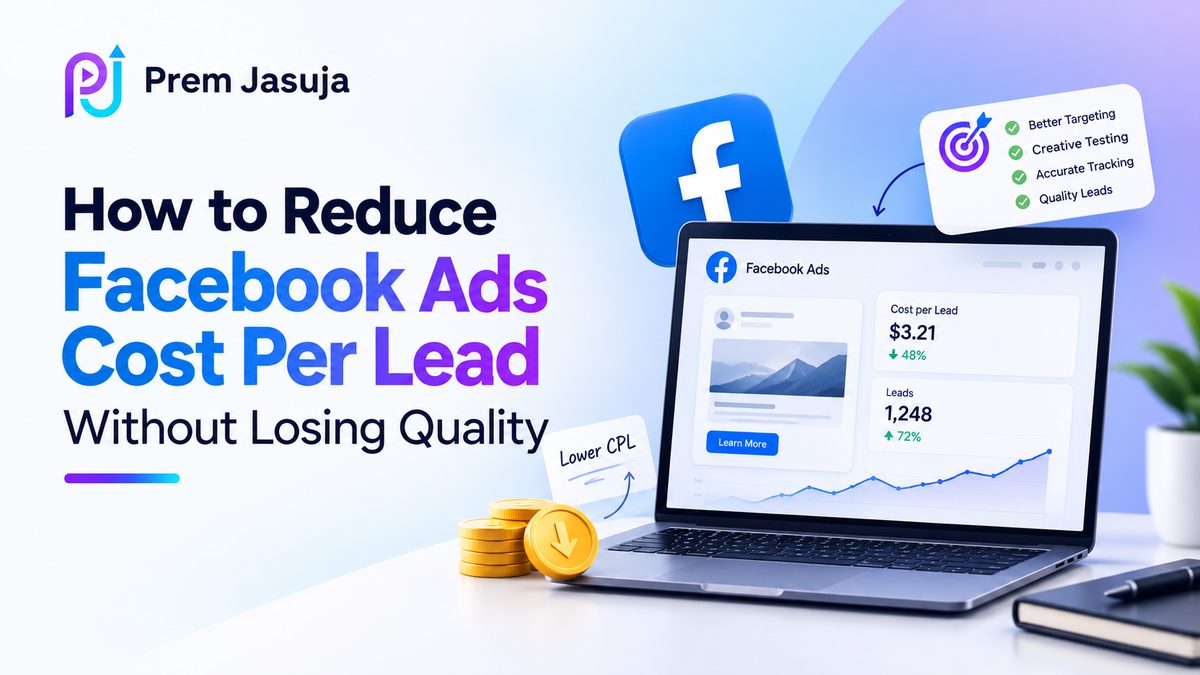
To reduce facebook ads cost per lead, focus on improving audience relevance, testing advertising creatives, simplifying campaign structure, optimizing landing pages, and sending Meta accurate conversion data.
You also need to measure lead quality rather than relying on cost per lead alone.
This guide explains how Facebook Ads cost per lead works, why advertising costs increase, and 12 practical ways to improve your campaign efficiency without sacrificing lead quality.
What Is Facebook Ads Cost Per Lead?
Facebook Ads cost per lead, commonly called CPL, measures how much advertising money a business spends to generate one lead.
A lead can be someone who submits a contact form, requests a quote, books a consultation, or expresses interest in a product or service.
For example, a digital marketing agency may run Facebook and Instagram advertisements encouraging business owners to request a consultation.
If the campaign generates 20 leads, the advertising platform can calculate the average amount spent to acquire each lead.
CPL helps businesses evaluate how efficiently their lead generation campaigns operate.
However, it does not measure whether those inquiries are relevant, qualified, or likely to become customers.
That is why a lower CPL should be evaluated alongside lead quality and sales performance.
How to Calculate Facebook Ads Cost Per Lead
The formula for calculating cost per lead is straightforward.
Cost Per Lead = Total Advertising Spend ÷ Number of Leads
For example, imagine your Facebook Ads campaign spends $600 and generates 30 leads.
Your average cost per lead would be:
$600 ÷ 30 = $20 per lead
Now imagine you improve the campaign and generate 40 leads with the same advertising budget.
Your new CPL becomes:
$600 ÷ 40 = $15 per lead
This represents a 25% reduction in cost per lead.
These numbers are illustrative, not actual campaign results.
The improvement is valuable if the additional leads are relevant to your business.
If the campaign generates more form submissions but fewer genuine prospects, the lower CPL may not produce better sales results.
What Is a Good Cost Per Lead for Facebook Ads?
There is no universal Facebook Ads cost per lead that every business should target.
The appropriate cost depends on factors such as industry, location, competition, advertising objective, product price, and lead quality.
For example, a local cleaning company may generate inquiries at a different cost from a B2B software company selling enterprise solutions.
A business offering a free downloadable guide may generate inexpensive email registrations, while a company requesting qualified consultation bookings may pay significantly more.
Instead of comparing your results only with general industry averages, review your own business economics.
Consider:
- Average customer value
- Customer acquisition cost
- Lead-to-customer conversion rate
- Profit margins
- Sales cycle length
- Average lifetime value
For example, suppose your business generates $1,000 in gross profit from a new customer.
If 10% of your leads become customers, every 10 leads generate approximately one customer.
A $25 CPL would mean approximately $250 in advertising costs per acquired customer, before accounting for other expenses.
Whether that is profitable depends on the rest of your business costs.
A good Facebook Ads CPL is one that helps your business acquire customers at an acceptable overall cost.
Why Is Your Facebook Ads Cost Per Lead Increasing?
Several factors can cause your Meta Ads campaigns to become more expensive.
One common reason is increased advertising competition.
When more advertisers compete for similar audiences, delivery costs can change.
Audience size also matters. Restrictive targeting can limit delivery opportunities, particularly when campaigns have small budgets.
Other potential causes include:
Weak Advertising Creatives: Your images, videos, or messaging may not attract relevant customers.
Poor Landing Page Experience: People click your ads but leave before completing the form.
Campaign Fragmentation: Too many similar ad sets divide the budget and available learning data.
Incorrect Conversion Tracking: Meta may receive inaccurate or incomplete information about results.
Audience Fatigue: People repeatedly see similar advertisements and become less responsive.
Unclear Offers: Potential customers may not understand why they should submit their information.
Changes in Customer Demand: Seasonal factors or market conditions can affect lead costs.
Before changing your campaigns, identify which factor is contributing to the problem.
12 Ways to Reduce Facebook Ads Cost Per Lead Without Losing Quality
Improving Meta Ads performance requires a combination of targeting, creative development, conversion tracking, and customer experience.
The following strategies can help identify opportunities to lower advertising costs while preserving lead quality.
1. Broaden Your Audience When Targeting Is Too Restrictive
Many advertisers assume that selecting more interests and demographics automatically produces better leads.
However, excessively narrow targeting can limit Meta's ability to find relevant customers.
For example, a home renovation company might select multiple detailed interests, narrow age groups, and several overlapping audience restrictions.
This can reduce the pool of people eligible to see its advertisements.
A broader audience may provide more opportunities for the delivery system to identify people likely to complete the selected conversion goal.
How to improve it:
Review your current audience size and targeting restrictions.
Remove unnecessary limitations that do not reflect actual business requirements.
Consider testing Advantage+ audience options where available.
Keep necessary restrictions such as relevant service locations and applicable advertising requirements.
What to measure: CPL, qualified leads, conversion volume, and cost per qualified lead.
Broad targeting is not guaranteed to outperform specific targeting. The goal is to find a useful balance between audience reach and relevance.
2. Use Advantage+ Placements to Expand Delivery Opportunities
Meta Ads can appear across different placements, including Facebook, Instagram, Messenger, and Audience Network, depending on campaign eligibility.
Some advertisers manually select only Facebook Feed or Instagram Feed because they assume these placements will perform best.
However, limiting placements can reduce available advertising opportunities.
Advantage+ placements allow Meta's delivery system to select from eligible placements based on the campaign objective.
This can help the system find conversion opportunities across a wider range of inventory.
How to improve it:
Review the placements currently used by your campaigns.
Test Advantage+ placements against a suitable existing setup when you have enough budget and data.
Make sure your images and videos display correctly across the selected formats.
For example, vertical videos may be better suited to Stories and Reels than wide landscape creatives.
What to measure: Campaign-level CPL, qualified leads, placement breakdowns, and conversion volume.
Do not exclude a placement simply because it has a higher cost per click. A higher CPC can still produce valuable leads.
Also, avoid judging the overall value of an automated placement strategy solely from isolated placement results.
3. Simplify Your Campaign and Ad Set Structure
A complicated Meta Ads account can make optimization more difficult.
For example, imagine a business has a small daily budget spread across 10 ad sets targeting similar audiences.
Each ad set may receive limited spending and generate only a few conversions.
This can make it harder to evaluate performance and provide sufficient learning data.
Meta recommends combining similar ad sets in appropriate situations to help improve delivery efficiency.
How to improve it:
Review your campaign structure and identify ad sets with similar objectives, audiences, and conversion goals.
Consider consolidating them when the separation serves no clear business purpose.
Maintain separate campaigns or ad sets when there are meaningful differences in locations, offers, reporting needs, or customer segments.
What to measure: Conversion volume, CPL, qualified lead rate, and consistency over time.
Campaign consolidation should make the account easier to manage without removing useful strategic distinctions.
4. Use Advantage+ Campaign Budget When Appropriate
Meta offers campaign-level budget allocation options that distribute spending across eligible ad sets.
Instead of manually assigning the same budget to every ad set, the system can allocate more spending toward opportunities it estimates are likely to produce results.
For example, a campaign with three ad sets may generate different results as competition and demand change.
Campaign-level budget optimization can adjust spending between those ad sets.
How to improve it:
Review whether your ad sets share a common objective and whether flexible budget allocation fits your strategy.
Consider testing Advantage+ campaign budget when you want Meta to distribute spending based on available opportunities.
Use appropriate controls when certain segments require minimum spending or separate management.
What to measure: Overall campaign CPL, lead quality, and total conversions.
A campaign-level budget does not guarantee the lowest cost for every individual ad set.
Evaluate the performance of the complete campaign.
5. Improve Your Advertising Creatives
Your advertising creative influences how potential customers respond to your campaign.
A strong image, video, headline, or primary text can help people understand what your business offers and whether it meets their needs.
For example, a generic advertisement saying "Grow Your Business Today" may attract attention but provide little information.
A more specific message such as "Professional Google Ads Management for eCommerce Brands" helps communicate the service and intended audience.
How to improve it:
Test different creative angles based on customer problems and desired outcomes.
These may include:
- A specific customer problem
- A service benefit
- A real customer testimonial
- A product demonstration
- An explanation of your process
- A clear consultation offer
Use genuine proof and avoid promising results that cannot be guaranteed.
For video advertisements, ensure the main message is understandable early and key text remains visible across placements.
What to measure: CTR, CPC, CPL, qualified leads, and sales outcomes.
Creative testing should focus on attracting the right customers, not merely generating more clicks.
6. Refresh Ads When Performance Shows Signs of Fatigue
Advertising fatigue can occur when the same people repeatedly see similar creatives.
You may notice declining engagement, increasing costs, or reduced response over time.
However, a high frequency number alone does not prove that an advertisement has become ineffective.
Some audiences need multiple interactions before taking action.
How to improve it:
Monitor frequency together with CTR, CPM, conversions, and lead quality.
Review performance trends over meaningful periods.
Test new images, opening messages, video hooks, or offers when evidence suggests that the existing creative is becoming less effective.
Avoid replacing every ad on a fixed weekly schedule.
An advertisement that continues generating valuable customers may not need immediate changes.
What to measure: CPL, conversion rate, qualified leads, frequency, and creative performance.
The objective is to maintain relevance without interrupting campaigns unnecessarily.
7. Improve Your Landing Page Conversion Rate
A Meta Ads campaign does not end when someone clicks an advertisement.
If your campaign sends people to a website, the landing page plays an important role in turning visitors into leads.
For example, imagine your advertisement offers a free roof inspection.
After clicking, visitors reach a page with a generic headline, unrelated services, and a long contact form.
Many people may leave before submitting their information.
Even if the advertising creative attracts relevant traffic, the landing page can limit results.
How to improve it:
Match the landing page headline with your advertisement.
Explain the offer clearly near the top of the page.
Make the main CTA easy to find.
Reduce unnecessary form fields and improve mobile usability.
Add genuine reviews, project examples, or other relevant trust signals.
What to measure: Landing page conversion rate, form completion rate, CPL, and qualified leads.
You can explore Landing Page Development to learn more about improving pages used in paid advertising campaigns.
8. Test Instant Forms Against Website Lead Forms
Meta allows eligible advertisers to collect leads through Instant Forms.
These forms open within Meta's environment, which can reduce the number of steps required to submit information.
Website lead forms provide more control over page design, content, qualification, and the overall customer experience.
Neither option is automatically better.
For a simple consultation offer, an Instant Form may make it easier for people to express interest.
For complex services, a dedicated landing page may provide the information visitors need before contacting your business.
How to improve it:
Test both approaches when they fit your goals.
For Instant Forms, consider the available form type and relevant qualifying questions.
For website forms, reduce unnecessary fields and ensure successful submissions are tracked correctly.
Compare results beyond the initial lead cost.
What to measure: Cost per lead, cost per qualified lead, booked appointments, and customer acquisition cost.
The winning option is the one that produces better business outcomes, not necessarily the cheapest form submissions.
9. Improve Lead Quality With Better Qualification
Low-cost leads are not always valuable.
Imagine two Meta Ads campaigns:
| Metric | Campaign A | Campaign B |
|---|---|---|
| Ad Spend | $1,000 | $1,000 |
| Leads | 100 | 50 |
| CPL | $10 | $20 |
| Qualified Leads | 10 | 30 |
| Cost per Qualified Lead | $100 | $33.33 |
Illustrative example only.
Campaign A appears more efficient because its CPL is lower.
However, Campaign B generates three times as many qualified leads and has a much lower cost per qualified lead.
This is why lead quality matters.
How to improve it:
Add relevant qualifying questions when needed.
For a B2B service, these may include company size, required services, or project timelines.
For local services, confirm that potential customers are within the service area.
Use contact information validation where suitable, while keeping the form easy to complete.
What to measure: Qualified lead rate, accepted leads, appointments, opportunities, and sales.
Avoid making forms unnecessarily complicated simply to filter out users.
10. Improve Conversion Tracking With Meta Pixel and Conversions API
Conversion tracking helps Meta understand which actions happen after someone interacts with an advertisement.
For website campaigns, this may include submitted forms, purchases, or confirmed bookings.
The Meta Pixel is a browser-based measurement tool.
Conversions API allows supported server-side or integration-based event sharing with Meta.
Together, they can support advertising measurement when implemented correctly.
However, duplicate or incorrect events can distort results.
How to improve it:
Review your current event configuration.
Confirm that a lead event occurs after a successful form submission rather than a button click.
Check whether the same event is sent through both browser and server integrations.
When the same event is shared through both methods, configure the appropriate matching event identifiers and deduplication process.
Review consent requirements and Meta's applicable data policies.
What to measure: Valid tracked leads, event matching, duplicate events, and reported conversion quality.
Explore Conversion Tracking Services if your existing tracking setup needs technical review.
11. Send Qualified Lead and Sales Data Back to Meta
A business may generate a lead today and close the sale several weeks later.
If Meta only receives information about the original form submission, it may not have enough feedback about which inquiries become customers.
CRM-based feedback can help connect advertising activity to later stages of the customer journey.
For example:
- Someone submits a Meta lead form.
- Your sales team contacts the prospect.
- The inquiry becomes a qualified lead.
- The customer books a consultation.
- The sale is completed.
When appropriate integrations and sufficient data are available, eligible downstream events can provide more useful optimization signals.
How to improve it:
Define meaningful sales stages in your CRM.
Keep lead statuses updated.
Use a supported integration to share permitted events with Meta.
Ensure customer data is handled according to relevant privacy requirements.
Review whether your selected campaign optimization goal supports the intended event type.
What to measure: Cost per qualified lead, cost per opportunity, customer acquisition cost, and revenue.
This approach can be especially useful for B2B companies, SaaS providers, and service businesses with longer sales processes.
12. Test Offers and Follow Up With Leads Quickly
Your advertisement may reach the right audience and use strong creative, but the offer still needs to be valuable.
For example, a generic message saying "Contact Us" gives little reason to act.
A more specific offer such as "Request a Consultation for Your Google Ads Account" explains what the visitor can expect.
Different audiences may respond to different offers, such as assessments, consultations, demonstrations, or pricing information.
Lead follow-up also matters.
A prospect who submits an inquiry may lose interest if nobody responds for several days.
How to improve it:
Test clear offers based on your customers' needs.
Make sure the offer matches what your business can genuinely deliver.
Send a confirmation message after form submission.
Establish a practical process for responding to new leads.
Monitor whether leads receive follow-up and what happens afterward.
What to measure: Form conversion rate, contact rate, appointment bookings, and closed sales.
Reducing CPL is useful, but improving the percentage of leads that become customers can have an even greater effect on profitability.
How to Reduce Facebook Ads CPL Without Reducing Lead Volume
Some businesses reduce lead costs by pausing campaigns or lowering budgets.
This may lower total advertising spending, but it can also reduce the number of leads generated.
If the goal is sustainable growth, you should monitor cost and volume together.
Start by identifying campaigns that generate suitable leads at an acceptable cost.
Review whether those campaigns have enough budget to capture available opportunities.
When increasing spending, make changes based on performance and the campaign's ability to handle additional demand.
Avoid assuming that doubling the budget will double the leads.
Meta's advertising auction can become more expensive as campaigns reach additional audiences and opportunities.
Similarly, avoid making frequent changes simply because one day produces a higher CPL.
Evaluate trends over a sufficient reporting period and consider lead quality.
How to Analyze Facebook Ads Cost Per Lead
A useful campaign report should include more than advertising spend and lead volume.
| Metric | What It Tells You |
|---|---|
| Ad Spend | Total advertising investment |
| Leads | Number of tracked inquiries |
| CPL | Average cost per lead |
| CPM | Cost per 1,000 impressions |
| CTR | How often people click after seeing an ad |
| CPC | Average cost per click |
| Form Conversion Rate | How often visitors or form openers complete the action |
| Qualified Leads | Number of inquiries matching your criteria |
| Cost per Qualified Lead | Advertising cost per qualified inquiry |
| Customer Acquisition Cost | Cost of acquiring a paying customer |
For example, high CPM may indicate more expensive advertising inventory, but it does not automatically mean the campaign is inefficient.
A campaign with higher CPM can still produce a low CPL when creative relevance and conversion performance are strong.
Similarly, a low CPC may not be valuable if visitors rarely become customers.
Review these metrics together to understand what drives costs.
Common Facebook Ads Mistakes That Increase CPL
Several common mistakes can make lead generation more expensive.
Changing Campaigns Too Frequently: Repeated edits can make performance harder to evaluate and may disrupt delivery.
Using Too Many Similar Ad Sets: Fragmented budgets can limit the data available to each ad set.
Ignoring Creative Performance: Weak messaging can attract irrelevant clicks or fail to communicate your offer.
Using Overly Restrictive Targeting: Very small audiences may limit delivery opportunities.
Poor Conversion Tracking: Incorrect events can distort reporting and optimization.
Focusing Only on Cheap Leads: Low CPL does not guarantee relevant customers.
Ignoring Lead Follow-Up: Delayed responses can reduce the value of otherwise promising inquiries.
Automatically Excluding Placements: Removing placements without testing may reduce useful delivery opportunities.
The best solution depends on the specific problem.
Avoid changing targeting, creative, bidding, and landing pages all at once without a clear testing plan.
Facebook Ads CPL Optimization Checklist
Before increasing or reducing your advertising budget, review the following:
- Campaign objectives match business goals.
- Audience targeting is not unnecessarily restrictive.
- Campaign and ad set structures are appropriate.
- Budget allocation supports important campaigns.
- Advantage+ placements have been evaluated.
- Advertising creatives clearly explain the offer.
- Performance is reviewed for possible creative fatigue.
- Landing pages are relevant and mobile-friendly.
- Instant Forms and website forms are evaluated where appropriate.
- Lead qualification is included where needed.
- Meta Pixel and Conversions API events are checked.
- Duplicate events have been reviewed.
- CRM lead statuses are monitored.
- Lead follow-up processes are working.
- CPL is reviewed alongside lead quality and sales.
This checklist helps identify the most important opportunities before making campaign changes.
When Should You Hire a Meta Ads Expert?
Some Facebook Ads campaigns can be managed internally, especially when a business has the time and experience to review performance regularly.
However, professional assistance may be useful when advertising costs increase without a clear explanation or campaigns struggle to generate qualified leads.
Consider working with a specialist if:
- Your CPL continues increasing.
- You receive too many irrelevant or fake leads.
- Your campaign structure is difficult to manage.
- Conversion tracking is missing or unreliable.
- You do not know which ads generate paying customers.
- You need to improve campaign creative and landing pages.
- You want to connect Meta Ads with your CRM and sales process.
A good Meta Ads specialist should understand your business model, explain the campaign strategy, and provide clear reporting.
The focus should be on generating suitable customers at an acceptable acquisition cost.
Why Work With Prem Jasuja for Meta Ads Management?
Prem Jasuja is a freelance digital marketing professional with experience in Meta Ads, Google Ads, SEO, and conversion tracking.
His work includes businesses operating in SaaS, eCommerce, and local services.
Each business needs a different approach to lead generation.
A local service business may focus on calls and appointment bookings.
A B2B company may prioritize qualified inquiries and sales consultations.
An eCommerce business may measure purchases, revenue, and return on ad spend.
Prem's approach focuses on reviewing campaign performance, understanding business goals, testing relevant advertising creatives, and improving conversion measurement.
Instead of judging results only by lead volume, the objective is to understand whether advertising contributes to meaningful customer acquisition.
Explore Meta Ads Management Services to learn more about campaign setup, testing, and ongoing optimization.
You can also view previous client projects to understand the types of businesses Prem has worked with.
Final Thoughts
Reducing facebook ads cost per lead does not always mean spending less money or reaching a smaller audience.
The goal is to make your advertising more efficient while attracting people who are genuinely interested in your business.
Start by reviewing audience targeting, campaign structure, budget allocation, and creative performance.
Then examine your landing pages, lead forms, and conversion tracking.
Most importantly, connect your advertising reports with lead quality and actual sales results.
A campaign producing inexpensive but irrelevant leads may be less profitable than one generating fewer, more qualified inquiries.
Meta Ads optimization is an ongoing process. Customer demand, competition, and audience behavior change over time.
Review results regularly, test meaningful improvements, and make decisions based on reliable data.
Need Help Reducing Your Facebook Ads Cost Per Lead?
If your Meta Ads campaigns generate expensive or low-quality leads, Prem Jasuja can help review your advertising strategy, campaign performance, creative testing, and conversion tracking.
Contact Prem Jasuja to discuss your business goals and explore how professional Meta Ads management may support your lead generation.
Frequently Asked Questions
What Is Facebook Ads Cost Per Lead?
Facebook Ads cost per lead is the average advertising amount spent to generate one lead. It is calculated by dividing total advertising spend by the number of leads generated during the reporting period.
How Can I Reduce Facebook Ads Cost Per Lead?
You can potentially reduce CPL by improving advertising creatives, testing broader audiences, simplifying campaign structure, optimizing landing pages, using suitable placements, and ensuring conversion tracking works correctly. Results depend on your business and campaign conditions.
What Is a Good Facebook Ads Cost Per Lead?
A good CPL depends on your industry, location, customer value, and lead-to-sale conversion rate. Compare your CPL with your actual customer acquisition economics rather than relying only on general advertising benchmarks.
Why Is My Facebook Ads CPL Increasing?
Your CPL may increase because of competition, audience limitations, weak advertising creatives, landing page problems, tracking errors, or changes in customer demand. Review campaign performance before deciding which changes to make.
Does Broad Targeting Reduce Facebook Ads Costs?
Broader targeting can give Meta more delivery opportunities and may reduce costs when audiences were previously too restrictive. However, it does not guarantee better results. Measure qualified leads as well as CPL.
Are Advantage+ Placements Better Than Manual Placements?
Advantage+ placements allow Meta to consider more eligible advertising placements. They may improve overall campaign efficiency, but the best setup depends on your creative assets, objectives, and performance data.
Should I Use Facebook Instant Forms or Landing Pages?
Both can work. Instant Forms reduce the steps required to submit information, while landing pages provide more space to explain complex offers and qualify visitors. Compare cost per qualified lead and sales outcomes.
How Does Lead Quality Affect Facebook Ads Performance?
Lead quality determines how useful inquiries are to your business. Low-cost leads that rarely become customers may provide less value than more expensive leads that convert into sales.
Can Meta Pixel and Conversions API Improve Lead Tracking?
Yes. When configured correctly, Meta Pixel and Conversions API can support measurement of website events and provide useful conversion information. Accurate implementation, deduplication, and applicable consent requirements are important.
How Often Should I Optimize My Facebook Ads Campaigns?
Review performance regularly, with a frequency appropriate to your spending and lead volume. Avoid unnecessary frequent changes, especially when campaigns are collecting data. Make adjustments when meaningful trends or clear problems justify them.