Your Facebook and Instagram advertisements are running. Your campaigns are spending money, reaching audiences, and generating clicks. Yet something does not add up.
Perhaps your cost per lead has increased. Your return on ad spend is becoming unpredictable. Or Meta Ads Manager reports conversions, but your business is not seeing a corresponding increase in customers.
When this happens, the usual response is to change the audience, refresh the creative, or increase the budget.
But what if the real problem is hidden somewhere else?
It could be inaccurate conversion tracking, an outdated campaign structure, poorly configured optimization goals, or an advertising strategy that no longer matches your business objectives.
This is where a Meta Ads audit becomes valuable.
A professional audit examines how your advertising account operates, where your money is going, and whether your campaigns are generating meaningful business results.
Rather than making random adjustments, it helps identify the problems that deserve attention first.
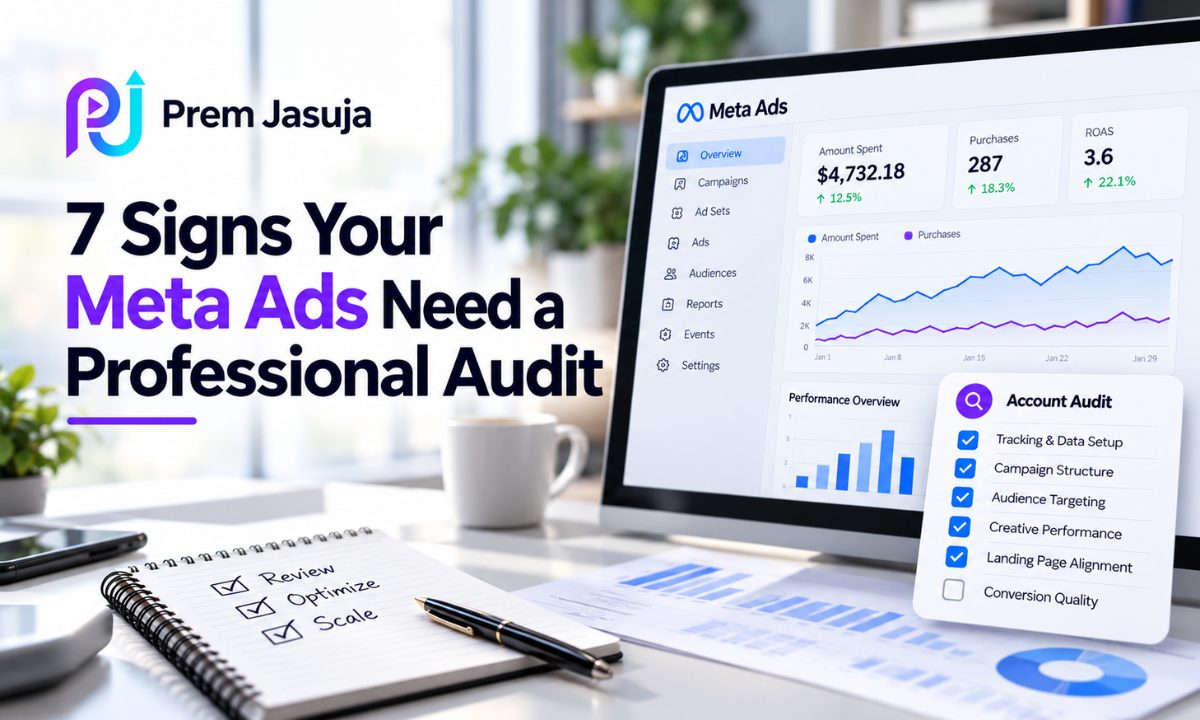
In this guide, we will explore seven signs your Meta Ads account may need a professional audit, what an audit should cover, and how a structured review can help you make more informed advertising decisions.
What Is a Meta Ads Audit?
A Meta Ads audit is a structured examination of your Facebook and Instagram advertising account to identify potential performance issues, tracking problems, inefficient spending, and opportunities for improvement.
It typically includes reviewing campaign objectives, ad set configurations, audience targeting, creative performance, budgets, conversion tracking, attribution settings, and landing pages.
However, an effective audit should go beyond checking whether settings are technically correct.
For example, an account may have properly configured advertisements but still generate irrelevant leads.
Another account might report an attractive return on ad spend while acquiring very few new customers.
A professional audit connects advertising metrics with the outcomes your business actually wants.
What Does a Meta Ads Audit Include?
| Audit Area | What Gets Reviewed |
|---|---|
| Campaign structure | Objectives, campaign organization, and budget allocation |
| Audience targeting | Locations, audience suggestions, exclusions, and customer relevance |
| Conversion tracking | Meta Pixel, Conversions API, event accuracy, and deduplication |
| Creative performance | Images, videos, ad copy, engagement, and creative fatigue |
| Budget and bidding | Spending distribution, cost per result, and optimization settings |
| Landing pages | Message consistency, speed, mobile experience, and conversions |
| Attribution and reporting | Reported results compared with CRM, website, and sales data |
| Business performance | Qualified leads, acquisition costs, purchases, and profitability |
The purpose is not to find as many problems as possible.
A useful Meta Ads audit identifies which issues affect business performance, how serious they are, and what should be improved first.
7 Signs Your Meta Ads Need a Professional Audit
1. Your Cost Per Lead or Customer Acquisition Cost Keeps Increasing
One of the clearest warning signs is a sustained increase in the amount you pay to acquire leads or customers.
For example, imagine your business previously generated qualified inquiries at an average cost of $25.
Over several weeks, that cost increases to $45 or $60 without a corresponding improvement in lead quality.
Your campaign may still be generating conversions, but your advertising economics have changed.
Several issues could contribute to this situation.
Your advertisements may be losing relevance, competition may have increased, or your website conversion rate may have declined.
Your campaign could also be spending more on audiences that produce fewer meaningful results.
What a professional audit should investigate
Start by examining cost per lead, cost per acquisition, and conversion rates over comparable periods.
Review whether the changes come from higher CPM, lower click-through rates, more expensive clicks, or declining conversion performance.
Analyze which campaigns, ad sets, creative concepts, and geographic markets account for the increased costs.
For lead-generation businesses, compare cost per lead with cost per qualified lead.
A campaign that produces cheaper inquiries is not necessarily better if those inquiries rarely become customers.
How to improve performance
Focus on the underlying problem rather than immediately reducing budgets.
If creative response has declined, test new messages or formats.
If traffic is relevant but website conversion rates are falling, investigate the landing page.
If leads have become less qualified, review advertising messages, forms, and conversion goals.
A rising CPA is an important signal, but it does not automatically mean a campaign should be paused.
The decision should reflect customer value and profitability.
2. Your Meta Pixel or Conversions API Tracking Is Unreliable
Conversion tracking is one of the most important areas of a professional Meta Ads audit.
If your tracking is inaccurate, the platform may report misleading results.
For example, imagine Meta Ads Manager reports 80 leads, but your CRM records only 45 completed inquiries.
This difference could result from attribution, event definitions, duplicated events, or other measurement issues.
It does not automatically prove that tracking is broken.
However, a substantial unexplained difference deserves investigation.
The Meta Pixel collects supported events through the browser.
Conversions API provides a way to send eligible events through a server or supported integration.
Both can contribute to conversion measurement, but they must be configured correctly.
Common tracking problems
- Lead events trigger when someone clicks Submit rather than after a successful submission.
- Purchase events fire multiple times.
- Browser and server events are not properly deduplicated.
- A website update breaks an existing tracking trigger.
- Conversion values are missing or incorrect.
- The campaign optimizes for low-value interactions instead of meaningful outcomes.
What a professional audit should investigate
Review Events Manager and identify the events your campaigns use for optimization.
Test important actions such as completed leads, registrations, and purchases.
Check event diagnostics and whether browser and server event information is configured appropriately.
When the same conversion is sent through Pixel and Conversions API, matching event names and event identifiers are important for deduplication.
Also compare your Meta reporting with website analytics, order records, or CRM data.
Different platforms may use different attribution methods, so the goal is to understand discrepancies rather than force identical numbers.
How to improve performance
Correct events that fire at the wrong moment.
Verify successful form submissions and completed purchases.
Resolve duplicate events and review event values.
Ensure your campaigns optimize toward actions that represent actual business value.
For businesses that depend on qualified inquiries, consider how sales and CRM data can support conversion quality measurement.
Explore Conversion Tracking Services for help evaluating advertising measurement.
3. Your Campaign Structure Has Become Complicated and Difficult to Manage
Another sign your Meta Ads account needs an audit is excessive campaign complexity.
Over time, businesses may create new campaigns for every promotion, product, location, or audience experiment.
Eventually, the account can contain numerous campaigns and ad sets competing for limited budget.
Some may have overlapping objectives.
Others may receive insufficient delivery to produce reliable performance insights.
However, more campaigns do not automatically mean an account is poorly structured.
The important question is whether the structure supports effective optimization and reporting.
Example
Imagine a local service business spending $60 per day.
Instead of running a focused lead-generation strategy, its budget is distributed across twelve active ad sets.
Each receives very little spending.
The business struggles to identify which messages or audiences generate suitable inquiries.
A simpler structure may make optimization easier.
But a larger eCommerce business selling different product categories may legitimately require several campaigns.
What a professional audit should investigate
Review active campaigns and ad sets.
Check whether campaign objectives reflect business goals.
Examine budget distribution and delivery status.
Identify duplicated campaigns, unnecessary segmentation, and overlapping experiments.
Review whether Advantage+ audience and automated placement options are being used appropriately.
Importantly, modern Meta targeting often treats interests and Lookalike Audiences as suggestions rather than strict restrictions.
An audit should evaluate how the selected campaign configuration actually works instead of relying on outdated assumptions.
How to improve performance
Consolidate campaigns or ad sets when fragmentation prevents useful optimization.
Separate activities when different business goals, offers, or geographic markets genuinely require independent budgets.
Choose campaign objectives that reflect the action you want customers to take.
Avoid rebuilding an entire account simply because its structure looks different from another advertiser's setup.
A good structure should support the business's decisions, not follow an arbitrary campaign-count rule.
4. Your Ad Creatives Are Losing Engagement and Performance
Creative fatigue is another reason to consider a Meta Ads audit.
An advertisement that performs well initially may become less effective after repeated exposure.
However, creative fatigue is not determined by the age of an advertisement alone.
A successful image or video may continue performing for months.
Another advertisement may lose effectiveness much sooner.
The difference depends on audience size, competition, frequency, customer response, and creative relevance.
Warning signs worth investigating
Your click-through rate may decline while cost per result increases.
Frequency may rise as the same audience repeatedly sees the advertisement.
Previously successful creatives may generate fewer conversions.
Alternatively, your campaigns may rely heavily on one message or format with little testing.
These patterns can suggest that your creative strategy needs attention.
What a professional audit should investigate
Review performance at the advertisement level.
Compare images, videos, carousels, testimonials, demonstrations, and different messaging approaches.
Analyze spend, impressions, CTR, CPC, conversions, and CPA.
Review frequency alongside changes in customer response.
For example, high frequency with stable conversions may not be a problem.
But increasing frequency, declining engagement, and rising CPA together provide a stronger reason to investigate fatigue.
How to improve performance
Introduce meaningful creative variations.
Instead of changing only colors or button text, test different customer insights.
An eCommerce brand might compare a product demonstration with a customer testimonial.
A B2B company might test a problem-focused advertisement against an implementation-focused message.
A local service business could compare service explanations, genuine customer proof, and location-specific creative.
The objective is to learn which messages attract valuable customers.
A professional creative audit should produce a testing strategy, not simply recommend replacing every advertisement.
5. Your Meta Ads Generate Leads but Not Actual Customers
Your Meta Ads account may report a strong conversion volume while your sales team receives very few suitable opportunities.
This often occurs when campaigns optimize for actions that are easy to generate rather than actions that indicate genuine customer interest.
For example, a B2B consulting business may receive many inquiries from students, job seekers, or individuals looking for free advice.
The cost per lead looks attractive in Ads Manager.
However, the business cannot convert most of those inquiries into paying clients.
In this situation, increasing lead volume may not solve the problem.
What a professional audit should investigate
Start with the campaign objective and optimization event.
Review whether the campaign is optimized for leads, purchases, traffic, or engagement.
Then evaluate lead quality using available sales or CRM information.
Check whether advertising messages explain who the service is for.
Review lead forms and qualification questions.
For example, a company serving established businesses might need to understand a prospect's organization, service requirements, or project scope.
The audit should also examine whether your advertising offer attracts people who are interested in the service or simply attracted by a free incentive.
How to improve performance
Use more specific advertising messages.
Clearly describe the intended customer and service.
Add useful lead qualification questions when appropriate.
Review whether a higher-intent form experience supports your goal.
Where feasible, connect qualified lead or customer outcomes with your campaign reporting.
Why Qualified Leads Matter More Than Cheap Leads
Consider this hypothetical example:
| Metric | Campaign A | Campaign B |
|---|---|---|
| Ad Spend | $1,000 | $1,000 |
| Leads Generated | 50 | 25 |
| Cost Per Lead | $20 | $40 |
| Qualified Leads | 5 | 15 |
| Cost Per Qualified Lead | $200 | $66.67 |
Campaign A appears more efficient if you only compare lead volume.
However, Campaign B generates more qualified leads for the same advertising spending.
This is why an audit should evaluate what happens after a lead is submitted.
For lead-generation businesses, cost per qualified lead and customer acquisition cost can be more useful than CPL alone.
6. Your ROAS or Advertising Reports Do Not Match Business Results
A common reason to request a professional Meta Ads audit is confusion about performance reporting.
For example, Ads Manager may report a 4x ROAS while the business's overall revenue remains relatively flat.
Alternatively, your store may generate more sales while Meta reports fewer attributed purchases.
These situations do not necessarily mean the advertising platform is inaccurate.
Different reporting systems can measure different things.
Meta Ads Manager attributes conversions according to its reporting settings and available signals.
Google Analytics measures website activity using its own methods.
An eCommerce platform records orders.
A CRM tracks lead progress and sales opportunities.
These numbers will not always match perfectly.
What a professional audit should investigate
Review attribution settings and reporting periods.
Compare attributed purchases with store orders and actual revenue.
Examine whether reported conversions include existing customers, retargeting activity, or repeat purchases.
Review the distinction between new-customer acquisition and existing-customer revenue where reliable data is available.
For eCommerce brands, analyze refunds, cancellations, and product margins where relevant.
For lead-generation businesses, compare Meta-reported leads against qualified leads and closed customers.
How to improve performance
Create a reporting structure that explains how different systems measure results.
Use consistent definitions for leads, purchases, qualified inquiries, and customer acquisition.
Do not rely on platform ROAS alone when deciding whether a campaign is profitable.
Review the customer journey and available business data.
A 4x ROAS can be attractive for one company and insufficient for another depending on margins, operating costs, and customer lifetime value.
An audit should help identify whether advertising performance supports real business growth.
7. Your Account Has Not Had a Structured Review in a Long Time
Your Meta Ads account may be performing reasonably well today.
But if nobody has completed a structured review for several months, important opportunities may remain unnoticed.
Advertising platforms change.
New campaign features become available.
Website functionality evolves.
Your products, pricing, and ideal customers may also change.
A campaign structure created for your business a year ago may no longer match your current priorities.
For example, a company that initially promoted one service may now offer several new services across additional markets.
Its older campaign configuration might not reflect those changes.
What a professional audit should investigate
Review whether current campaigns reflect the business's latest objectives.
Check conversion tracking after website or CRM changes.
Evaluate audience settings, creative strategy, budget allocation, and existing campaign experiments.
Review account access and management responsibilities.
Businesses should retain appropriate administrative control over their advertising assets and understand who has permission to manage them.
Also examine whether advertising decisions are documented and supported by performance data.
How to improve performance
Establish a regular performance review process.
Document meaningful optimizations and their intended outcomes.
Review tracking after important website updates.
Schedule a deeper audit when your business changes direction, campaign results become difficult to explain, or you plan a significant increase in advertising spend.
There is no universal rule requiring a complete audit every 30 days.
The appropriate frequency depends on spending, account complexity, business risk, and the number of changes being made.
What Should a Professional Meta Ads Audit Actually Deliver?
A useful audit should provide more than a list of warnings.
It should help you understand which issues matter most and what action should follow.
A professional review should generally produce a clear summary of account performance, an explanation of significant findings, and a prioritized optimization plan.
For example, imagine an audit identifies these issues:
- Purchase events are being recorded twice.
- Campaigns are optimizing for an inappropriate conversion goal.
- A high-spend advertisement has declining performance.
- The checkout page has a technical issue.
These problems should not receive equal priority.
Incorrect conversion data may undermine the reliability of reporting and automated optimization.
A broken checkout can prevent actual sales.
Those issues may deserve attention before testing a new audience.
How to Prioritize Audit Recommendations
| Priority | Example Finding | Recommended Approach |
|---|---|---|
| Critical | Duplicate purchase events | Investigate and correct measurement |
| High | Campaign objective misaligned with sales | Review optimization goal |
| High | Checkout or form not functioning | Repair and test conversion process |
| Medium | Creative response declining | Develop structured creative tests |
| Medium | Fragmented campaign budget | Evaluate consolidation |
| Lower | Inconsistent campaign naming | Improve account organization |
The exact priority should depend on business impact.
A professional audit should distinguish confirmed problems from hypotheses that require further testing.
Can You Audit Your Meta Ads Account Yourself?
Yes. Business owners and marketing teams can complete useful account reviews internally.
Meta Ads Manager provides reporting on campaigns, ad sets, advertisements, spending, and results.
Events Manager provides diagnostic information about conversion tracking.
Your website analytics and CRM can offer additional context.
A self-audit can help identify problems such as broken events, inappropriate campaign objectives, poor landing page performance, and inefficient budget allocation.
However, an independent perspective may be valuable when your team cannot explain performance fluctuations or has become accustomed to the current account structure.
The main benefit of professional auditing is not simply access to Meta Ads Manager.
It is the ability to connect technical findings with commercial decisions.
Meta Ads Audit Checklist for Business Owners
Use this checklist when reviewing your account:
- Campaign objectives match business goals.
- Primary optimization events represent valuable outcomes.
- Meta Pixel is installed and functioning.
- Conversions API is reviewed where implemented.
- Duplicate browser and server events are checked.
- Conversion values are accurate.
- Campaign budgets align with priorities.
- Ad sets are not unnecessarily fragmented.
- Geographic targeting reflects the business market.
- Audience suggestions and controls are understood.
- Creative performance is evaluated using meaningful metrics.
- New creative concepts are tested when appropriate.
- Lead quality is reviewed beyond form submissions.
- Landing pages match advertisement messaging.
- Forms and checkout processes work correctly.
- Attribution settings are understood.
- CRM or store results are compared with platform reporting.
- Optimization changes are documented.
- Scaling decisions consider customer acquisition economics.
This checklist can reveal areas that deserve further investigation.
However, checking every box does not guarantee profitable campaigns.
The quality of the conclusions and follow-up decisions matters more than the number of settings reviewed.
How Much Does a Poorly Optimized Meta Ads Account Cost Your Business?
The financial impact depends on the size of your advertising budget and the cause of underperformance.
For example, imagine a business spending $3,000 per month on Meta Ads.
Its current cost per qualified lead is $150.
That produces 20 qualified leads.
Now imagine the same spending generates 30 qualified leads after tracking, creative, and landing page improvements.
Its cost per qualified lead becomes $100.
| Metric | Before | Illustrative After |
|---|---|---|
| Monthly Spend | $3,000 | $3,000 |
| Qualified Leads | 20 | 30 |
| Cost Per Qualified Lead | $150 | $100 |
These figures are hypothetical and do not represent guaranteed audit results.
This example illustrates why improving conversion quality can matter more than simply generating additional clicks.
It is also important to recognize that an audit does not automatically deliver these improvements.
An audit identifies issues and recommends actions.
The outcome depends on implementation, customer demand, competition, and the business itself.
How Often Should You Conduct a Meta Ads Audit?
The appropriate frequency depends on how your account operates.
For businesses running smaller campaigns, regular performance monitoring and periodic deeper reviews may be sufficient.
Businesses spending larger budgets or managing many products and geographic markets may need more frequent structured checks.
An audit can be particularly useful when costs increase significantly, conversions become unreliable, your website changes, or you prepare to scale advertising.
You may also benefit from a review when changing agencies, introducing new products, or adopting new measurement integrations.
Do not confuse regular campaign monitoring with a comprehensive account audit.
Monitoring identifies changes as they happen.
A comprehensive audit investigates the underlying relationships between tracking, campaign structure, creative performance, customer behavior, and business outcomes.
Why Work With Prem Jasuja for a Meta Ads Audit?
Prem Jasuja is a freelance digital marketing professional with experience in Meta Ads, Google Ads, conversion tracking, landing page development, and digital marketing strategy.
His work includes SaaS companies, eCommerce businesses, B2B organizations, and local service providers.
Different businesses require different advertising measurements.
For an eCommerce store, the priority may involve purchase tracking, product-level performance, and return on ad spend.
For a local service business, qualified calls, inquiries, and booked appointments may be more valuable.
For a B2B business, the focus may include lead qualification and customer acquisition costs.
A useful Meta Ads audit should reflect these differences rather than apply identical recommendations to every business.
Prem's approach focuses on understanding campaign performance, reviewing tracking accuracy, identifying potential spending inefficiencies, and evaluating how advertising contributes to meaningful business outcomes.
You can explore Meta Ads Management Services, learn more about Conversion Tracking, or review previous projects.
Final Thoughts
A Meta Ads audit can help you understand why your advertising results have changed and which improvements deserve attention.
Rising acquisition costs, inaccurate tracking, complex campaign structures, weak creative performance, low-quality leads, confusing attribution, and outdated account configurations are all reasons to investigate.
However, not every unusual metric represents a serious problem.
A high CPM does not automatically mean an audience is poor.
A higher cost per lead may be acceptable when those leads are substantially more qualified.
And a campaign with fewer ad sets is not automatically better than a more complex account.
The goal of a professional audit is to identify genuine performance limitations and build an informed action plan.
Before increasing spending or rebuilding your campaigns, make sure you understand where your budget goes, what your advertisements are optimizing for, and whether your business is receiving valuable outcomes.
A successful audit should help you make better advertising decisions, not simply generate a longer list of problems.
Need a Professional Meta Ads Audit?
If your Facebook or Instagram campaigns are spending money without producing enough qualified leads or sales, a structured account review can help identify potential improvements.
Contact Prem Jasuja to discuss your Meta Ads account, conversion tracking, creative performance, and advertising objectives.
Frequently Asked Questions
What Is a Meta Ads Audit?
A Meta Ads audit is a structured review of a Facebook and Instagram advertising account. It examines campaign objectives, budgets, targeting, conversion tracking, creative performance, attribution, and landing pages to identify performance issues and improvement opportunities.
How Do I Know if My Meta Ads Need an Audit?
Common warning signs include rising acquisition costs, inconsistent ROAS, inaccurate conversion tracking, declining creative performance, low-quality leads, complicated campaign structures, and unclear advertising results.
What Does a Professional Meta Ads Audit Include?
A professional Meta Ads audit generally includes campaign structure analysis, audience and location targeting reviews, Meta Pixel and Conversions API checks, creative evaluation, budget analysis, conversion tracking verification, and landing page assessment.
How Often Should I Audit My Meta Ads Account?
The appropriate frequency depends on spending, account complexity, and business requirements. Regular monitoring is useful, while deeper audits may be appropriate after major performance changes, website updates, agency transitions, or plans to increase advertising budgets.
Can I Perform a Meta Ads Audit Myself?
Yes. You can review campaigns, spending, targeting, tracking, and creative performance through Meta Ads Manager and Events Manager. A professional audit may provide additional value when problems are complex or an independent assessment is needed.
Can a Meta Ads Audit Help Reduce Wasted Spending?
An audit can identify spending inefficiencies related to targeting, conversion tracking, campaign structure, creative performance, and landing pages. Improvements may help advertising budgets generate more valuable results, but savings are not guaranteed.
Does a Meta Ads Audit Include Pixel and Conversions API Tracking?
A comprehensive audit should review relevant conversion tracking configurations, including Meta Pixel, Conversions API where implemented, event accuracy, deduplication, and whether important business actions are measured correctly.
Why Is My Meta Ads Cost Per Lead Increasing?
Cost per lead may increase because of auction competition, declining creative performance, changes in traffic quality, landing page problems, or conversion measurement issues. An audit can help determine which factors contribute to the change.
What Is the Difference Between a Meta Ads Audit and Meta Ads Management?
A Meta Ads audit evaluates account performance and identifies issues or opportunities. Meta Ads management involves implementing, monitoring, testing, and optimizing advertising campaigns on an ongoing basis.
Should I Audit My Meta Ads Before Increasing My Budget?
A structured audit is often valuable before significant budget increases. It helps confirm that conversion tracking is reliable, campaign objectives are appropriate, customer acquisition costs are understood, and the business can support additional advertising spending.