Your Google Ads campaigns are running, visitors are clicking your advertisements, and your advertising budget is being spent. But one important question remains: are you sending those visitors to the right page?
Many businesses invest time optimizing keywords, bidding strategies, headlines, and targeting while overlooking the destination visitors reach after clicking an advertisement.
That destination can influence whether someone contacts your business, requests a quote, books an appointment, or makes a purchase.
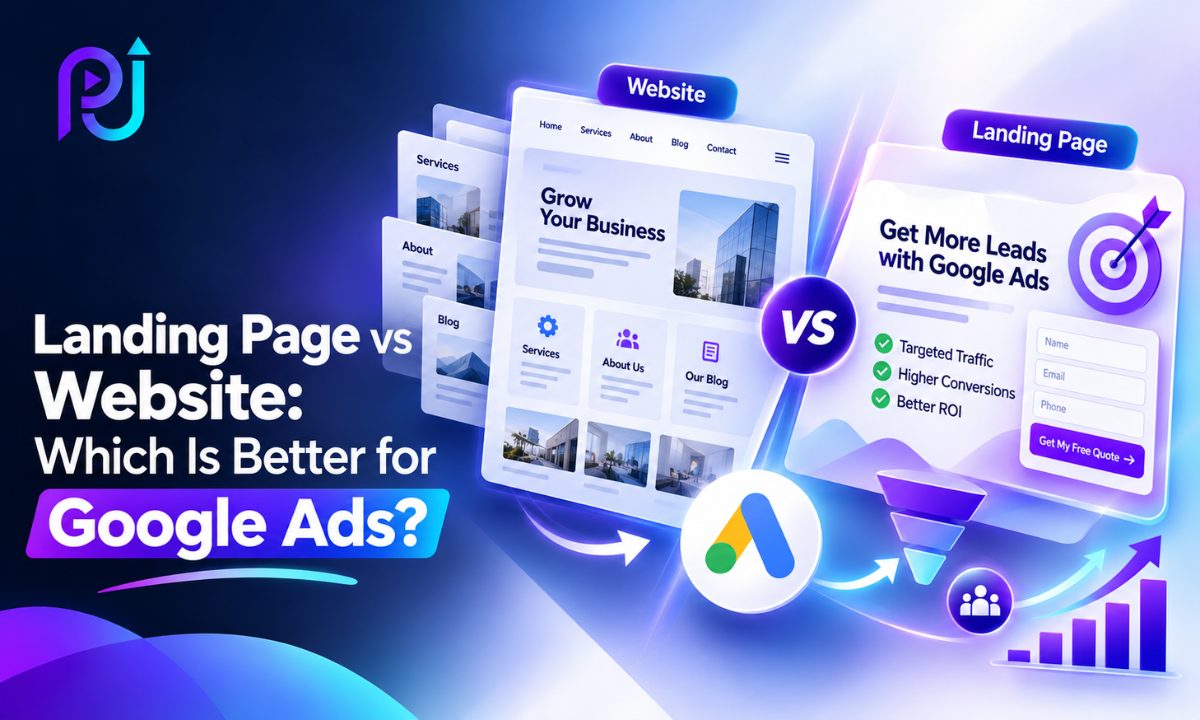
When comparing landing page vs website, the main difference is purpose. A dedicated landing page usually focuses on one campaign, service, or offer, while a general website helps visitors explore a business and its wider range of services.
For Google Ads, a dedicated landing page is often useful for specific, high-intent campaigns. However, an existing service page or homepage can be equally suitable when it closely matches the search intent and makes conversion easy.
The right decision depends on what your potential customer is searching for, what your advertisement promises, and what information the visitor needs before taking action.
In this guide, we will compare landing pages and websites, explain how each affects Google Ads performance, and show you how to choose the right destination for better conversions and lead quality.
What Is a Landing Page?
A landing page is the webpage someone reaches after clicking an advertisement, email link, or another marketing promotion.
In Google Ads terminology, a landing page is the page associated with your advertisement's final URL.
This means your homepage, product page, or service page can technically be a landing page.
However, in digital marketing, the term dedicated landing page commonly refers to a page created for a specific campaign or conversion objective.
For example, imagine a business offers several digital marketing services, including SEO, Google Ads, Meta Ads, and website development.
If the business runs a campaign targeting "Google Ads management services," it may create a page focused specifically on Google Ads management.
That page could explain the service, highlight relevant experience, answer common questions, and encourage visitors to request a consultation.
The visitor does not need to search through unrelated services to find the information promised by the advertisement.
What Is the Main Purpose of a Landing Page?
A dedicated landing page is designed to guide visitors toward a primary action.
That action might include booking a consultation, requesting a quote, submitting a contact form, registering for a demo, or purchasing a product.
A successful landing page should explain the offer clearly, establish trust, and make the next step straightforward.
However, focusing on one action does not mean removing all useful information or navigation.
Visitors should still have access to important business details, relevant policies, and supporting information when needed.
What Is a Website?
A website is a collection of connected pages that introduce a business, explain its services, and support different customer needs.
A typical business website may include a homepage, about page, service pages, portfolio, testimonials, blog, and contact page.
Unlike a dedicated landing page, a website usually serves visitors with several different intentions.
Someone might visit your website to learn about your company. Another visitor may want pricing information or customer reviews. Others may wish to compare services before contacting your business.
For example, an auto detailing company may have individual website pages for interior detailing, scratch repair, paint protection film, and ceramic coatings.
The website allows customers to explore these different options.
This broader experience is valuable, particularly when people are still researching their needs.
However, it can become less effective when an advertisement promotes a very specific service that is difficult to find on the homepage.
Landing Page vs Website: Key Differences
The main differences involve visitor intent, content focus, navigation, and conversion objectives.
| Factor | Dedicated Landing Page | General Website |
|---|---|---|
| Purpose | Encourage a specific action | Provide broader business information |
| Target Audience | Usually campaign-specific | Multiple customer groups |
| Content | Focused on one service or offer | Covers multiple subjects or services |
| Navigation | Often simplified | Generally broader |
| CTA | One main conversion objective | May have several objectives |
| Advertising Relevance | Tailored to the campaign | Depends on the selected page |
| Lead Qualification | Can use campaign-specific messaging | Can qualify visitors through detailed service content |
| Conversion Tracking | Supports focused measurement | Equally trackable with correct setup |
| Best Use | Specific paid campaigns | Brand searches, research, and broader discovery |
Neither is automatically better in every situation.
A well-designed service page can outperform a poorly built dedicated landing page.
Likewise, a focused campaign page may perform better than a general homepage that requires visitors to search for the advertised service.
The best choice is the destination that meets customer expectations and supports the desired business outcome.
Why Does Landing Page vs Website Matter for Google Ads?
Every Google Ads click brings a visitor with a particular expectation.
Someone who searches for "emergency plumbing repair" is likely looking for immediate assistance.
Someone searching for "how plumbing systems work" probably wants educational information.
These visitors should not necessarily receive the same landing page experience.
Imagine a user searches for "car scratch repair in Ottawa" and clicks an advertisement for scratch removal.
If the advertisement directs the person to a homepage promoting auto detailing, ceramic coatings, window tinting, and other services, the visitor may struggle to find scratch repair information.
Now imagine that same visitor lands on a page explaining scratch repair services in Ottawa, relevant work examples, and how to request a quote.
The second destination provides a clearer connection between the search, advertisement, and service.
This connection is commonly called message match.
Better message match can help visitors understand that they have reached the right page.
It does not guarantee conversion, but it removes an unnecessary obstacle from the decision-making process.
7 Reasons a Dedicated Landing Page Can Be Better for Google Ads
1. Stronger Alignment With Search Intent
A dedicated landing page can be written specifically for the keywords and search terms used in a campaign.
For example, a business advertising Power BI dashboard development could direct visitors to a page explaining Power BI implementation, dashboard design, and business reporting.
Sending the same visitors to a generic technology consulting homepage might make the relevant information harder to find.
A focused page makes it easier for visitors to understand whether the service meets their needs.
2. A Clearer Call to Action
A dedicated landing page usually highlights one primary conversion goal.
For a local contractor, this could be "Request a Project Estimate."
For a SaaS business, it might be "Book a Product Demo."
A clear CTA tells visitors what will happen next and makes the conversion process easier to understand.
You can repeat the same action naturally throughout the page without adding unrelated offers.
3. More Relevant Service Information
A general homepage may only briefly mention each service.
A dedicated page can explain the advertised service in greater detail.
For example, an advertisement promoting custom refrigeration container rentals should lead to information about refrigerated containers, available specifications, rental options, and quotation requests.
Relevant information helps potential customers evaluate the offer without unnecessary navigation.
4. Better Opportunities to Qualify Leads
Not every inquiry represents a suitable customer.
A dedicated landing page can explain important requirements, service areas, project types, or other qualification details.
For example, a B2B consulting business may explain that its services are designed for companies requiring Power BI implementation rather than individual training.
Clear messaging can help attract better-fit prospects and reduce confusion.
5. Easier Campaign-Specific Testing
Dedicated pages make it practical to test alternative headlines, images, forms, or offers without changing your general website experience.
For example, a business could compare a page emphasizing affordability with one emphasizing specialist expertise.
By keeping other campaign conditions reasonably consistent, the business can evaluate which approach produces more valuable inquiries.
6. Fewer Unnecessary Distractions
A homepage may promote several services, recent articles, company updates, and other destinations.
A dedicated landing page can prioritize the information needed for the advertised offer.
However, removing all navigation is not automatically beneficial.
People may still need access to important information such as business credentials, policies, or contact details.
The objective is to reduce confusion, not prevent visitors from making informed decisions.
7. More Control Over the Customer Journey
A dedicated page lets you arrange information in a sequence that supports the intended action.
For example, you might begin with the service and main benefit, followed by genuine customer proof, an explanation of the process, FAQs, and a consultation form.
This approach can make the page easier to understand, particularly for visitors who arrive with a specific need.
When Is a Website Better Than a Dedicated Landing Page?
There are several situations where an existing website page may be the more appropriate choice.
Branded Search Campaigns
When someone searches for your business name, they may want to explore your services, reviews, contact information, or company background.
A homepage can work well when it provides that information clearly.
Existing High-Quality Service Pages
Your website may already include detailed service pages with relevant content, genuine proof, and strong CTAs.
If these pages match the advertisement and work properly on mobile devices, creating duplicates may be unnecessary.
It may be more efficient to improve the existing page and test its performance.
eCommerce Product Campaigns
If a user clicks an advertisement for a specific product, the relevant product page is often an appropriate destination.
The page should provide accurate pricing, availability, product details, delivery information, and a purchase option.
A separate lead-generation-style landing page is not necessarily useful for this type of shopping journey.
Complex B2B Services
Some services require more research before a customer makes contact.
For example, enterprise analytics consulting may involve technical requirements, budgets, implementation processes, and multiple decision-makers.
Visitors may benefit from access to case studies, detailed service descriptions, and related company information.
A well-structured service page can support those needs.
Limited Development Budget
If a small business already has a relevant service page, improving that page may be a better initial investment than commissioning a new landing page.
The decision should be based on what is missing from the existing page rather than an assumption that every campaign requires a new design.
Landing Page vs Website Conversion Rate: Which Performs Better?
A dedicated landing page may improve conversion rates when it matches the advertisement more closely and makes the desired action easier.
However, there is no universal conversion rate advantage that applies to every dedicated landing page.
Performance also depends on traffic quality, product pricing, competitiveness, trust, and the conversion process.
Example: Comparing Two Google Ads Destinations
Imagine a business spends $1,500 on Google Ads and receives 600 visitors.
| Metric | Homepage | Dedicated Landing Page |
|---|---|---|
| Ad Spend | $1,500 | $1,500 |
| Visitors | 600 | 600 |
| Conversion Rate | 2.5% | 5% |
| Leads | 15 | 30 |
| Cost Per Lead | $100 | $50 |
This is a hypothetical comparison, not an actual client result.
In the example, the dedicated page generates more inquiries from the same advertising budget.
However, the business should also measure whether those inquiries become qualified leads and customers.
A page producing 30 irrelevant inquiries may be less valuable than one producing 15 serious prospects.
The most useful comparison includes both conversion volume and customer quality.
How Landing Page Experience Affects Google Ads Quality Score
Google Ads Quality Score is a diagnostic metric used to evaluate expected click-through rate, ad relevance, and landing page experience.
Landing page experience considers whether a page is useful and relevant to the people clicking an advertisement.
For example, someone searching for "commercial cold storage container rental" should reach a destination containing meaningful information about refrigerated container rental services.
A generic container sales homepage may provide a less relevant experience if the advertised service is difficult to find.
Google also considers aspects of usability, including navigation and whether the page meets the expectations created by the advertisement.
However, an important distinction is that Quality Score itself is not a direct input into Google's ad auction.
It is a diagnostic tool.
Improving page relevance and usefulness can support a better user experience and may contribute to advertising efficiency, but it does not guarantee a specific Quality Score, CPC, or ad position.
Rather than focusing only on the score, evaluate whether the page genuinely helps visitors accomplish their goals.
What Should a High-Converting Google Ads Landing Page Include?
A useful landing page should combine clear messaging, relevant information, trust, and a straightforward conversion process.
A Headline That Matches the Advertisement
The headline should immediately identify the product or service.
For example, "Professional Car Scratch Repair in Ottawa" is more specific than "Experience Automotive Excellence."
A Clear Value Proposition
Explain what the customer receives and why the service is relevant.
Avoid vague claims that could describe almost any business.
A Visible Primary CTA
Examples include "Request a Quote," "Book a Consultation," and "Schedule a Demo."
The CTA should accurately describe the action.
Relevant Trust Signals
Use genuine reviews, project examples, case studies, credentials, and business contact information.
Do not invent testimonials or advertise guarantees that your business cannot support.
Useful Service Details
Explain what is included, who the service is for, and any important restrictions or conditions.
A focused page should still provide enough information for customers to make a decision.
A Simple Contact Form
Only request the information needed for the next step.
However, some businesses may require qualification questions to avoid unrelated inquiries.
Mobile-Friendly Design
Visitors should be able to read content, use buttons, and complete forms without unnecessary difficulty.
Fast Loading Performance
Optimize large images, unnecessary scripts, and technical problems that slow down the page.
Accessible Business Information
Keep important details such as contact information, privacy policies, or relevant service conditions accessible.
Reliable Conversion Tracking
Measure successful form submissions, confirmed bookings, and purchases rather than relying only on button clicks.
Should You Create a Separate Landing Page for Every Google Ads Campaign?
Not necessarily.
Separate pages are useful when campaigns promote meaningfully different services, products, locations, or offers.
For example, an automotive service business may run campaigns for auto detailing, car scratch repair, and paint protection film.
These services have different customer expectations.
Each may benefit from a dedicated page containing relevant information.
However, closely related keywords such as "professional auto detailing" and "car detailing service" may work well with the same page.
Creating near-duplicate pages for every keyword can increase maintenance work without providing additional value.
Group search terms according to customer intent.
Then select or create pages that address those needs clearly.
Landing Page vs Website for Different Google Ads Campaigns
Different campaign types may need different destinations.
| Campaign Type | Recommended Starting Point |
|---|---|
| Brand Search | Homepage or relevant branded page |
| Non-Brand Search | Service-specific landing page or existing service page |
| Local Lead Generation | Relevant service page with location and contact information |
| eCommerce Search | Product or category page |
| Shopping | Relevant product page |
| Performance Max | Relevant service, category, or product pages |
| Remarketing | Page matching the visitor's previous interest |
| B2B Lead Generation | Detailed service or consultation page |
For Performance Max campaigns, also review final URL expansion settings where relevant, because automated destination selection may affect which pages users reach.
The campaign type provides context, but the visitor's needs should guide the final destination decision.
How to Track Landing Page Conversions in Google Ads
Conversion tracking is essential when comparing two destination pages.
Without accurate measurement, you may choose a page because it receives more clicks even though it generates fewer customers.
Google Ads, Google Analytics 4, and Google Tag Manager can help measure relevant actions.
Common conversions include contact form submissions, confirmed bookings, purchases, and qualified inquiries.
However, not every interaction represents a completed lead.
A phone-number click does not prove that a customer completed a call.
Similarly, clicking a form's submit button does not confirm that the submission succeeded.
Configure tracking to measure completed actions whenever possible.
For example, a successful form submission could trigger a dedicated event after the website confirms that the request was received.
For eCommerce campaigns, purchase events should represent completed transactions with appropriate values.
Also review whether Google Ads is optimizing toward the correct conversion actions.
Learn more about Conversion Tracking Services if your campaigns need reliable measurement.
How to A/B Test a Landing Page Against Your Homepage
The most reliable way to compare two suitable pages is to test them under reasonably similar conditions.
Step 1: Choose One Campaign
Select a campaign with a clear goal and sufficient traffic to support evaluation.
For example, a local plumbing company might test its existing emergency plumbing service page against a new campaign-specific page.
Step 2: Define the Conversion Goal
Decide whether success means a completed form, confirmed booking, purchase, or another business action.
Avoid changing the definition of a conversion during the test.
Step 3: Create the Alternative Page
Build a variation that addresses a specific weakness in the original destination.
For example, improve the service headline, contact form, offer explanation, or placement of customer proof.
Step 4: Use a Suitable Experiment
Use an appropriate website or Google Ads testing method where available.
Keep audiences, offers, and campaign conditions comparable.
Step 5: Gather Meaningful Data
Do not declare a winner after a small number of visitors or a few conversions.
Consider traffic volume, conversion counts, and normal variations in customer demand.
Step 6: Compare Lead Quality
Review which page generates inquiries that match your business requirements.
For B2B campaigns, consider consultation bookings, qualified opportunities, and eventual sales.
Step 7: Make an Evidence-Based Decision
Choose the better-performing experience according to your primary business goal.
If the existing website page performs better, continue improving it.
If the dedicated page performs better, evaluate whether its structure could benefit other relevant campaigns.
Common Mistakes When Choosing a Google Ads Destination
Sending Every Advertisement to the Homepage
A homepage may not explain the specific service promised by an advertisement.
Instead, choose the most relevant page.
Creating Landing Pages With Too Little Information
A page containing only a headline and form may fail to answer important questions.
Visitors still need useful service details and credibility information.
Removing All Navigation
Simplifying navigation can help visitors focus, but hiding necessary business information can reduce trust.
Using Identical Pages for Different Services
Different customer needs may require distinct content and conversion paths.
Ignoring Mobile Usability
An effective desktop experience does not guarantee an effective mobile experience.
Test the complete conversion process on smartphones.
Choosing Based Only on CPL
Low-cost leads may not become paying customers.
Include qualified lead volume and customer acquisition costs when evaluating the destination.
Making Multiple Changes Simultaneously
Changing targeting, advertising copy, offers, and landing pages at the same time makes performance differences harder to interpret.
Use a clear testing plan.
How to Decide Between a Landing Page and Website
Before creating a dedicated landing page, review your campaign using these questions.
What is the customer searching for?
Identify the purpose behind the search.
What does the advertisement promise?
Ensure the destination clearly provides that offer.
Does an existing page already answer the visitor's questions?
Review your current service and product pages.
Can visitors easily take the intended action?
Check the CTA, contact form, phone options, and purchase process.
Does the page establish enough trust?
Make sure relevant proof and business information are accessible.
Can you track successful conversions?
Verify measurement before spending heavily on campaign traffic.
If your existing website page satisfies these requirements, it may be a suitable destination.
If your campaign requires more targeted messaging or a different conversion experience, a dedicated landing page may be worth developing.
Do You Need Both a Website and Landing Pages?
For many businesses, the most practical approach is to use both.
Your website provides a central source of information about the company, its services, experience, and policies.
Dedicated landing pages support particular advertisements and offers.
For example, a home services company may maintain website pages for plumbing, electrical services, and maintenance.
It may also create campaign-specific pages for emergency repairs or seasonal promotions.
This approach allows visitors to explore the broader business when needed while providing focused information for specific advertisements.
The goal is not to replace your website with landing pages.
It is to ensure each Google Ads campaign directs visitors to the most useful destination.
When Should You Hire a Landing Page Developer?
Some optimization tasks can be completed with your existing website builder.
You may be able to update a headline, improve CTA placement, or simplify a contact form.
However, professional assistance can be valuable when your website requires technical improvements or dedicated conversion-focused development.
Consider working with a landing page developer when your advertisements generate traffic but few inquiries, existing pages do not match your campaign offers, mobile forms are difficult to use, or conversion tracking is unreliable.
Professional development may also help when you want to create and test multiple page variations.
The objective should be to improve the complete customer journey rather than simply create a visually attractive page.
Why Work With Prem Jasuja for Google Ads and Landing Pages?
Prem Jasuja is a freelance digital marketing professional specializing in Google Ads, Meta Ads, SEO, conversion tracking, and landing page development.
His experience includes work with SaaS businesses, eCommerce stores, and local service providers.
Effective Google Ads management involves more than keyword targeting and advertising copy.
The page visitors reach should also support the campaign objective.
For example, a Google Ads campaign promoting auto detailing should direct potential customers to a page that clearly explains the relevant service and provides an appropriate booking or inquiry option.
A B2B consulting campaign may require more detailed information about services, business outcomes, and the consultation process.
Prem's approach focuses on aligning campaign messaging, landing page relevance, and conversion measurement with the business's goals.
Explore Google Ads Management Services and Landing Page Development Services to learn more.
You can also review previous projects for information about relevant experience.
Final Thoughts
So, landing page vs website: which is better for Google Ads?
A dedicated landing page is often useful when an advertisement promotes a specific service, product, or offer.
However, an existing homepage or service page may perform equally well when it matches customer intent, provides relevant information, and makes taking action easy.
Rather than assuming one format will always convert better, evaluate the destination based on visitor needs and actual performance.
Review the keyword, advertisement, page content, user experience, and conversion tracking.
Then test meaningful improvements.
A successful Google Ads campaign does not end when someone clicks the advertisement. It continues until the visitor finds the information they need and has a clear opportunity to become a customer.
Need Help Improving Your Google Ads Landing Page?
If your Google Ads campaigns generate traffic but not enough qualified leads, Prem Jasuja can help review your campaign destinations, landing page experience, and conversion measurement.
Contact Prem Jasuja to discuss your advertising and landing page requirements.
Frequently Asked Questions
Is a Landing Page Better Than a Website for Google Ads?
A dedicated landing page can be better when a campaign promotes one specific service, product, or offer. An existing website page can also work well when it matches the advertisement and provides a clear conversion path.
Can I Use My Homepage for Google Ads?
Yes. A homepage can be used for Google Ads, particularly for branded campaigns or businesses with simple offerings. For more specific searches, a relevant service or product page may be more suitable.
Do Landing Pages Convert Better Than Websites?
A dedicated landing page may convert better when it provides stronger message matching and a clearer user journey. However, there is no universal guarantee. Results depend on the audience, offer, credibility, and website experience.
Does Google Ads Require a Separate Landing Page?
No. Google Ads does not require a separately designed campaign page. Your homepage, product page, or service page can be the destination as long as it meets applicable advertising policies.
Does Landing Page Experience Affect Google Ads Quality Score?
Yes. Landing page experience is one component of the Quality Score diagnostic metric. Quality Score itself is not a direct input in Google's ad auctions.
Do I Need a Landing Page for Every Google Ads Campaign?
Not necessarily. Separate pages are useful for campaigns with meaningfully different services, offers, or customer needs. Closely related campaigns may share one suitable page.
Should a Google Ads Landing Page Have Navigation?
A landing page can use simplified navigation, but visitors should still be able to access relevant business information, service details, and important policies.
What Is a Good Google Ads Landing Page Conversion Rate?
There is no universal conversion rate target. Performance depends on your industry, offer, audience, traffic source, and conversion goal. Compare results against your own baseline and business economics.
How Can I Compare a Landing Page With My Website?
Use a suitable experiment with comparable traffic conditions. Measure completed conversions, cost per lead, qualified inquiries, and customer acquisition costs rather than relying only on clicks.
Should I Build a New Landing Page or Improve My Existing Service Page?
Start by reviewing your existing service page. If it already matches the advertisement and works well for visitors, improving it may be sufficient. Build a dedicated page when your campaign needs more specific content, messaging, or testing flexibility.