You have a small business website. You are investing in SEO, publishing content, and trying to improve your Google rankings. But the most important question remains: how long does SEO take to bring actual customers?
It is a reasonable question. Small business owners need to know when their marketing investment might start producing inquiries, appointments, and sales.
Unlike Google Ads, where paid visibility can begin shortly after a campaign is approved and starts delivering, SEO usually takes longer to develop.
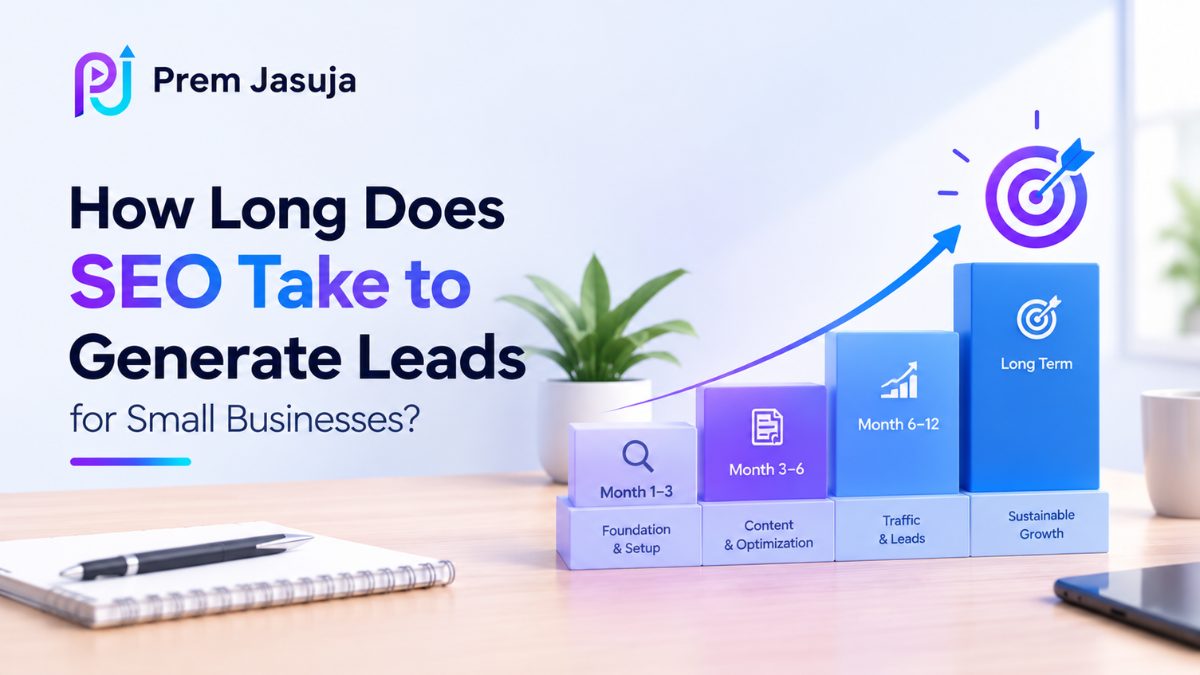
For many small businesses, early SEO improvements may appear within 3 to 6 months, while more consistent organic traffic and lead generation may take 6 to 12 months or longer. These are planning estimates, not guarantees. Some established websites improve faster, while new websites in competitive industries may need considerably more time.
The timeline depends on your website's existing condition, competition, keywords, content, technical performance, and SEO strategy.
In this guide, you will learn what happens during the first 12 months of SEO, what influences results, how to measure progress, and when you might start generating qualified leads from Google Search.
How Long Does SEO Take? The Short Answer
If you are starting SEO for your small business, think in months rather than days.
Some technical improvements can influence search visibility relatively quickly. Others need time before their impact becomes noticeable.
Google's SEO Starter Guide explains that website changes can take anywhere from a few hours to several months to affect search results.
This means that an SEO campaign does not follow a fixed schedule.
However, a practical planning framework can help set expectations.
| SEO Timeline | Main Focus | What You May Notice |
|---|---|---|
| Month 1 | Website audit and strategy | Technical issues identified and baseline established |
| Months 2–3 | Technical fixes and content optimization | Initial indexing, impressions, or ranking changes |
| Months 4–6 | Content expansion and search visibility | More relevant search impressions, clicks, and possible early leads |
| Months 7–9 | Authority and commercial keyword growth | Broader visibility and opportunities for qualified inquiries |
| Months 10–12 | Refinement and ongoing optimization | Potentially more consistent organic traffic and lead generation |
| After 12 months | Long-term improvement | Opportunities to maintain, expand, and improve results |
These stages are illustrative.
A business with established rankings and useful content may generate additional leads much sooner.
A new business entering a highly competitive market may take longer than a year to achieve its main goals.
The most important question is not only how quickly your rankings improve.
It is whether those rankings attract people who are likely to become customers.
Why Does SEO Take Time to Show Results?
Search engine optimization involves more than inserting keywords into website pages.
Google needs to discover, crawl, process, and evaluate content before it can appear in relevant search results.
Search engines also consider the usefulness of a page, the searcher's intent, and how content compares with other available results.
For example, imagine you start a new plumbing company and create a website targeting "plumber in Austin."
Your website may compete against established local businesses with years of relevant content, customer reviews, and existing search visibility.
Even if your new website looks professional, Google does not automatically place it above existing competitors.
You need to build pages that answer customer questions, make your services understandable, and provide a useful website experience.
Technical SEO can help search engines access the site.
Relevant content helps visitors find answers.
Internal links improve navigation and connect related pages.
Trustworthy mentions and backlinks may strengthen the website's visibility over time.
The process is ongoing because competitors and search results can also change.
There is no guaranteed waiting period after which Google must reward your SEO work with higher rankings.
What Happens During the First 12 Months of SEO?
A realistic SEO strategy should include clear activities and measurable progress throughout the year.
The following roadmap shows how a small business might organize its SEO work.
Month 1: SEO Audit, Research, and Website Assessment
The first month should focus on understanding your current website and identifying obstacles.
An SEO specialist may review your website structure, existing content, indexing status, internal links, page performance, and competitors.
Important activities include:
- Technical SEO audit
- Google Search Console setup
- Google Analytics 4 review
- Keyword research
- Competitor analysis
- Website structure assessment
- On-page SEO recommendations
- Initial content planning
- Conversion tracking review
For example, a local electrician may discover that important service pages are missing, several pages have duplicate titles, and the website does not clearly mention its service locations.
These issues should be addressed before expecting substantial growth.
What should you expect?
The main outcome should be a clear SEO strategy, a record of current performance, and a prioritized action plan.
Large ranking improvements are not required for the first month to be productive.
Months 2–3: Technical Improvements and On-Page SEO
Once the initial audit is complete, the next step is implementation.
Technical SEO improvements may include fixing important crawling problems, reviewing canonical tags, resolving broken internal links, and improving website navigation.
On-page optimization may involve updating headings, page titles, meta descriptions, and existing service content.
For example, a landscaping company might improve a generic "Services" page by creating useful pages for lawn maintenance, garden design, and seasonal cleanup.
Each page should explain the service and answer relevant customer questions.
Internal links can connect these pages with related information and make them easier to discover.
What should you expect?
Some websites may begin receiving additional impressions for relevant searches.
Previously overlooked pages may become indexed.
You might notice ranking changes for certain long-tail keywords.
However, these improvements may not immediately translate into additional leads.
Months 4–6: Search Visibility and Early Opportunities
By this stage, some optimized pages may have gained more exposure in search results.
You may notice improvements in organic impressions, clicks, and visibility for specific service-related searches.
For example, a roofing business targeting "roof leak repair in Denver" may begin appearing for more relevant variations of that search.
Its pages could attract visitors looking for repair services.
If the website provides helpful information and clear contact options, some visitors may submit inquiries.
What should you expect?
Possible developments include:
- Increased impressions for relevant keywords
- More clicks to optimized pages
- Improved positions for selected searches
- Growth in non-branded organic traffic
- Initial inquiries from commercial pages
Not every business will experience these results during this period.
A new website in a competitive industry may still be building visibility.
Review progress relative to your starting point rather than assuming every keyword should reach page one.
Months 7–9: Building Topical Coverage and Commercial Visibility
At this stage, your SEO strategy can focus on expanding content around services that matter most to your business.
For example, an accounting firm may already have a main tax preparation page.
It can improve its website by adding relevant information about business tax preparation, bookkeeping, and financial reporting.
Supporting blog content can answer related customer questions.
Internal links can help readers move between educational resources and the relevant service pages.
You may also develop relationships with relevant local organizations or industry publications that lead to genuine mentions and links.
What should you expect?
Some businesses may begin seeing a broader set of keywords generating visits.
Established service pages may attract more relevant inquiries.
However, traffic and leads can still fluctuate because of seasonality, competition, and changes in search behavior.
Months 10–12: Measuring Business Results and Improving What Works
Toward the end of the first year, review the impact of your SEO investment.
Do not focus only on how many blog articles were published.
Evaluate whether the website is attracting the right people and generating valuable business actions.
Review:
- Organic traffic growth
- Qualified leads
- Contact form submissions
- Phone inquiries
- Service page performance
- Search visibility for commercial keywords
- Website conversion rates
- Revenue influenced by organic search
For example, if a particular service page generates valuable inquiries, consider improving its content, internal links, and conversion experience.
If an informational blog receives substantial traffic but produces little business value, review how it supports the customer journey.
What should you expect?
Some websites may have developed more consistent organic lead generation by this point.
Others may still need substantial work, especially in competitive industries.
Use the results to determine which parts of the strategy deserve more attention.
How Long Does SEO Take for a New Website?
New websites often need more groundwork than established websites.
An established business may already have indexed pages, relevant backlinks, returning visitors, and search visibility.
A new website may have none of these advantages.
For example, imagine two businesses offering the same service.
Business A has operated its website for several years and already appears for relevant local searches.
Business B launched a new website last week.
Business A may be able to improve an existing page and gain additional traffic relatively quickly.
Business B may need to build an initial collection of useful pages and establish visibility from the beginning.
However, website age alone does not guarantee strong rankings.
A newer website can perform well when it offers relevant information, meets customer needs, and competes effectively for appropriate searches.
For a new website, focus first on technical accessibility, essential service pages, clear navigation, and realistic keyword opportunities.
Do not publish large amounts of low-quality content simply to make the website appear bigger.
How Long Does Local SEO Take for Small Businesses?
Local SEO focuses on improving visibility for searches connected to particular locations.
Examples include:
- Dentist in Chicago
- Office cleaning in London
- Roofing contractor in Dallas
- Self storage in Hobart
- Electrician near me
Local SEO may offer opportunities sooner than broad national SEO when competition is limited and the business serves a specific area.
However, competitive cities and industries can still require substantial work.
A local SEO strategy may include optimizing your Google Business Profile, improving service pages, checking business information, earning relevant reviews, and building useful local content.
For example, a plumbing company serving three cities may benefit from service-area information that clearly explains where it operates.
It should not create dozens of nearly identical location pages that provide no unique value.
What Should You Measure?
Review your Google Business Profile performance alongside organic search results.
Look at relevant search visibility, customer calls, website visits, direction requests where applicable, and actual bookings.
Local ranking positions may vary by the searcher's location.
That is why one screenshot of a Google Maps result is not enough to measure local SEO performance.
What Factors Affect How Long SEO Takes?
Several factors influence how quickly a website can make progress.
1. Keyword Competition
Broad commercial keywords can attract many competitors.
For example, "SEO services" is likely to be more competitive than a specific service query in a smaller location.
Targeting useful long-tail searches can provide opportunities to reach customers with clearer intent.
2. Website Condition
A technically healthy website may be easier to crawl and navigate.
If important pages cannot be indexed or the site has major accessibility problems, those issues need attention.
Fixing them does not guarantee higher rankings, but it removes potential barriers.
3. Existing Content
An established website with useful service pages may already have a strong starting point.
Improving these pages can sometimes be more effective than creating entirely new content.
4. Content Quality and Search Intent
Your content should answer what people are genuinely searching for.
For example, a person searching "how to fix a leaking roof" may want instructions.
Someone searching "emergency roof repair service" may be ready to hire a contractor.
These searches require different content.
5. Relevant Backlinks and Mentions
Links from trustworthy, relevant websites can help users discover your content and support search visibility.
However, buying manipulative links or creating large numbers of irrelevant backlinks can create risks.
Focus on earning links through useful resources, genuine relationships, and relevant industry activity.
6. Website User Experience
Search visibility is only one part of acquiring customers.
Visitors must also be able to understand your offer, navigate the website, and contact your business.
Slow pages, broken forms, and confusing navigation can reduce the value of organic traffic.
7. Consistency of Implementation
An SEO strategy needs ongoing attention.
Publishing one blog and making a few title changes is not the same as implementing a complete SEO program.
Regular work provides more opportunities to identify and improve weak areas.
Consistency does not guarantee rankings, but it supports a structured approach.
How Long Does SEO Take to Generate Leads?
Generating leads from SEO can take longer than generating initial search impressions.
A page may start appearing in Google Search before it receives many clicks.
It may receive clicks before enough visitors are ready to contact your business.
This happens because different search queries reflect different stages of the buying journey.
For example, someone searching "what is commercial cleaning" may be researching a topic.
Someone searching "commercial cleaning quote in Manchester" is more likely to be evaluating a service provider.
Both visits can have value, but the second search has clearer commercial intent.
A useful SEO lead generation strategy should prioritize service pages and relevant buying-intent keywords, while also publishing educational content that supports customers earlier in their research.
Illustrative Lead Generation Example
Imagine a local service website gradually increases its monthly organic visitors.
| Metric | Starting Point | Later Scenario |
|---|---|---|
| Monthly organic visitors | 200 | 800 |
| Website lead conversion rate | 2% | 3% |
| Monthly leads | 4 | 24 |
| Leads becoming customers | 25% | 25% |
| Estimated new customers | 1 | 6 |
These figures are hypothetical and illustrate how traffic and conversion rate can work together.
Actual SEO results will vary.
The example also demonstrates why increasing traffic alone is not enough.
If your website attracts more visitors but has an unclear offer or broken contact form, lead growth may remain limited.
How to Measure SEO ROI for Your Small Business
SEO return on investment should consider the business value created by organic traffic.
Tracking only keyword rankings gives an incomplete picture.
For example, suppose your business spends $6,000 on SEO over a period.
During the same period, you attribute $15,000 in revenue to customers acquired through organic search.
Using revenue, the simple return calculation would be:
($15,000 − $6,000) ÷ $6,000 × 100 = 150%
However, this is not a net-profit ROI calculation because it excludes product or service delivery costs and other business expenses.
For a more useful financial assessment, consider attributable gross profit, SEO costs, and the time between a lead and a completed sale.
Track the customer journey through your CRM where possible.
This is especially important for businesses with long sales cycles.
A B2B company may generate a qualified SEO inquiry in one month and close the deal several months later.
Your reporting should account for that delay.
How to Know Whether SEO Is Working Before Leads Arrive
You do not have to wait for substantial sales growth before evaluating SEO progress.
Google Search Console and GA4 can provide useful information about visibility and website activity.
Organic Impressions
Impressions indicate how often pages from your website appeared in eligible Google Search results.
An increase may show that your content is appearing for more searches.
However, impressions can also rise because of broad informational searches that have limited commercial value.
Organic Clicks
Clicks measure visits generated through Google Search.
Review which pages and queries attract visitors.
Look for growth in relevant service-related searches rather than focusing only on total volume.
Average Position
Google Search Console provides an average position metric for your search appearances.
This is not a fixed ranking.
Positions can vary by search query, location, device, and other conditions.
Use the metric to investigate trends rather than treating every small change as a major result.
Website Conversions
GA4 can help measure meaningful website events such as successful contact form submissions and bookings.
For phone leads, consider an appropriate call measurement solution when needed.
Track verified customer actions rather than only button clicks.
For help with measurement, explore Conversion Tracking Services.
Qualified Leads
A website might generate 30 inquiries, but only 10 may match the business's services, locations, or customer requirements.
Tracking qualified leads helps you understand whether SEO is attracting suitable prospects.
Why Your SEO May Not Be Generating Results After Six Months
If you have invested consistently in SEO but see little progress, it is worth reviewing the strategy.
However, six months without major lead growth does not automatically prove that the work has failed.
Start by examining the following issues.
Incorrect Keyword Targeting: You may be focusing on keywords that generate information-seeking traffic rather than relevant customers.
Technical Problems: Important pages may have indexing or accessibility issues.
Weak Service Pages: Your commercial pages may not clearly explain the services customers need.
High Competition: Your target keywords may be dominated by well-established competitors.
Insufficient Content Quality: Existing pages may lack useful information or fail to satisfy search intent.
Poor Internal Linking: Relevant pages may be difficult for visitors and crawlers to discover.
Website Conversion Problems: People may visit but fail to contact the business because of weak CTAs or broken forms.
Measurement Gaps: Conversion tracking may not accurately capture inquiries or phone calls.
A proper review should identify which problem matters most before recommending more content or backlinks.
Can You Speed Up SEO Results?
You cannot force Google to rank a website by a particular date.
However, you can avoid unnecessary delays and make your SEO work more focused.
Improve Existing Pages First
Review pages that already receive relevant impressions and clicks.
Some may benefit from more useful content, clearer headings, better internal links, or improved conversion elements.
Target Realistic Search Opportunities
Focus on keywords relevant to your services and current competitive position.
A smaller number of useful, high-intent searches can be more valuable than broad traffic with little business potential.
Fix Critical Technical Issues
Address problems affecting indexing, internal navigation, and important website functionality.
Build Relevant Content Clusters
Create supporting content around your main services.
For example, an accounting firm's tax service page could link to articles answering relevant business tax questions.
Each article should provide genuine value instead of repeating the same information with different keywords.
Earn Relevant Links Naturally
Useful industry resources, original research, partnerships, and authentic business mentions can create opportunities for trustworthy backlinks.
Avoid shortcuts that violate search engine spam policies.
Improve Landing Page Conversions
Better page messaging and contact options can help turn existing organic traffic into more leads.
Learn more about Landing Page Development.
The objective is to improve the overall customer journey, not simply publish more pages.
SEO vs. Google Ads: Which Generates Leads Faster?
SEO and Google Ads serve different purposes.
Google Ads can generate paid search visibility relatively quickly after campaigns are launched and eligible to run.
SEO can help develop organic visibility over time without paying for each search click.
However, neither channel guarantees leads.
| Factor | SEO | Google Ads |
|---|---|---|
| Initial visibility | Usually develops over time | Can begin after campaign launch and approval |
| Traffic cost | No charge per organic click | Advertising costs apply |
| Ongoing investment | SEO work and maintenance | Media budget and management |
| Long-term visibility | Successful pages may continue attracting traffic | Paid delivery depends on ongoing budget |
| Main measurement | Organic traffic, leads and revenue | Attributed conversions, CPA and ROAS |
| Best use | Building relevant organic discovery | Reaching eligible audiences through paid advertising |
For small businesses that need inquiries immediately, Google Ads may complement a longer-term SEO strategy.
For example, a local contractor may use paid Search campaigns to reach people actively requesting services while improving its organic service pages.
As organic visibility develops, the business can evaluate how both channels contribute to customer acquisition.
Explore Google Ads Management if you want to compare paid and organic search strategies.
What Should an SEO Specialist Deliver Each Month?
A professional SEO service should provide clear information about work completed, performance changes, and priorities.
A useful monthly report may include:
| Area | What to Report |
|---|---|
| Organic Visibility | Impressions, clicks, CTR and relevant query trends |
| Keyword Performance | Important search queries and landing page visibility |
| Technical SEO | Issues identified and completed fixes |
| On-Page SEO | Pages optimized and changes implemented |
| Content | New or updated pages and their purpose |
| Internal Linking | Relevant links added or improved |
| Authority Building | Earned mentions and relevant backlinks |
| Lead Generation | Forms, calls, bookings and qualified inquiries |
| Next Steps | Prioritized actions for the coming month |
Business owners should be able to understand what the SEO work is achieving.
Reports should not consist only of complex dashboards or long lists of keywords.
A good specialist should explain what has improved, what still needs attention, and how the next steps support the business's goals.
Common SEO Mistakes That Delay Results
Some mistakes can make SEO unnecessarily slow or less effective.
One common problem is targeting only highly competitive keywords without building supporting content.
Another is publishing large numbers of thin pages that provide little original value.
Businesses may also overlook technical problems while continuing to create new articles.
Other issues include:
- Ignoring search intent
- Duplicating location pages
- Neglecting internal links
- Focusing on backlink quantity over relevance
- Not updating important service information
- Measuring traffic without measuring leads
- Failing to monitor Search Console
- Making major website changes without SEO planning
Avoid shortcuts that promise guaranteed rankings.
The better approach is to improve the website systematically and evaluate meaningful business outcomes.
Small Business SEO Checklist
Use this checklist to assess your current strategy.
- Google Search Console is configured.
- Important pages can be crawled and indexed.
- Target keywords match customer needs.
- Main service pages have useful content.
- Page titles and headings are clear.
- Internal links connect relevant pages.
- Local business information is accurate.
- Mobile users can navigate the website easily.
- Important forms and contact options work.
- Organic leads are measured accurately.
- Content addresses real customer questions.
- Monthly SEO performance is reviewed.
- The strategy is updated when evidence supports changes.
Not every business needs every SEO tactic immediately.
Prioritize the improvements most relevant to your website and customers.
When Should You Hire an SEO Expert?
Some small business owners manage basic SEO tasks themselves.
You can update page content, improve service descriptions, and review Search Console without hiring a full-time specialist.
However, professional support may be useful when you need technical SEO work, detailed keyword research, content planning, or help identifying why your website is not generating leads.
Consider hiring an SEO expert if:
- Important pages are not appearing in Google Search.
- Organic traffic has remained low for an extended period.
- You are unsure which keywords deserve attention.
- Your business operates in a competitive market.
- Your website contains technical or indexing issues.
- Organic visitors are not becoming customers.
- Your existing SEO reports do not explain performance clearly.
A good SEO professional should be realistic about timelines and explain the proposed work.
Avoid providers who guarantee specific Google rankings by a fixed date.
Why Work With Prem Jasuja for SEO?
Prem Jasuja is a freelance digital marketing professional with experience in SEO, Google Ads, Meta Ads, and conversion tracking.
His work includes SaaS companies, eCommerce stores, and local service businesses.
An effective SEO strategy should begin with your business objectives.
For a local service company, this may mean improving visibility for relevant services and locations.
For an eCommerce store, it may involve optimizing product categories, collections, and informational content.
For a B2B company, the focus may include commercial service pages and content that addresses decision-makers' questions.
Prem's approach focuses on identifying search opportunities, reviewing technical and content issues, and connecting website visibility with measurable business results.
Explore SEO Services to learn more about improving your website's organic search presence.
You can also review previous client projects for information about the types of businesses Prem has supported.
Final Thoughts
So, how long does SEO take to generate leads for a small business?
For planning purposes, many businesses should allow several months for early search visibility improvements and potentially 6 to 12 months or longer for more consistent lead generation.
However, there is no guaranteed SEO timeline.
Results depend on your industry, website condition, competition, keywords, content, and customer demand.
Rather than judging success only by rankings, focus on attracting relevant organic traffic and converting visitors into customers.
Track impressions, clicks, commercial search visibility, qualified leads, and revenue.
Review your strategy regularly and prioritize work that supports your business goals.
SEO is not simply about appearing higher on Google. It is about becoming easier for the right customers to discover and choose.
Need Help Building a Realistic SEO Strategy?
If your small business website is not attracting enough organic visitors or generating qualified inquiries, Prem Jasuja can help review your SEO opportunities and identify practical improvements.
Contact Prem Jasuja to discuss your website and business goals.
Frequently Asked Questions
How Long Does SEO Take to Show Results?
Some SEO changes can affect search visibility within days or weeks, while broader improvements may take several months. Many businesses use a 3-to-6-month period to assess early progress, but results are not guaranteed.
How Long Does SEO Take to Generate Leads for a Small Business?
Some businesses may generate organic leads within the first few months, especially if they already have relevant rankings. More consistent lead generation may take 6 to 12 months or longer, depending on competition, website quality, and search demand.
Can SEO Work in 30 Days?
Yes, certain technical fixes or page improvements may affect search visibility within 30 days. However, major traffic growth and consistent lead generation usually require more time, and results vary.
How Long Does Local SEO Take?
Local SEO may show improvements within a few months in less competitive markets. Businesses in competitive cities or industries may need more time. Results depend on existing visibility, website quality, business information, and local competition.
Does a New Website Take Longer to Rank?
A new website may need more time to build visibility because it has fewer existing pages, links, and search performance signals. However, domain age alone does not determine rankings.
How Can I Tell Whether SEO Is Working?
Monitor relevant organic impressions, clicks, search visibility, indexed pages, and website conversions. The most meaningful business measures are qualified leads, customers, and revenue attributable to organic search.
Can Paying More for SEO Make Results Faster?
A larger budget can support additional content, technical work, and specialist resources. However, spending more money does not guarantee faster rankings or a particular result.
Is SEO Better Than Google Ads for Small Businesses?
SEO and Google Ads serve different purposes. Google Ads can provide paid visibility quickly, while SEO develops organic visibility over time. Many small businesses benefit from combining both approaches.
Why Is My SEO Not Generating Leads After Six Months?
Possible reasons include targeting the wrong keywords, high competition, technical issues, weak service pages, poor conversion tracking, or an ineffective customer journey. Review search visibility and lead quality before deciding what to change.
Does SEO Need Ongoing Maintenance?
Yes. Search behavior, competitors, website content, and search systems change over time. Regular monitoring and relevant improvements can help maintain and develop organic visibility.