Google Ads has changed how advertisers can reach people searching for products and services.
For years, Search campaign management focused heavily on selecting keywords, writing advertisements, adjusting bids, and directing visitors to specific landing pages.
Those elements still matter. However, Google's advertising automation can now use more signals to identify relevant searches and adapt advertisements.
One of these features is Google Ads AI Max.
AI Max brings additional automation to existing Search campaigns. It can expand search term matching, generate relevant advertising text, and select landing pages based on the user's search intent.
That sounds useful, especially for businesses trying to generate more leads or sales.
But should every advertiser enable it?
Not necessarily.
Automation can help discover valuable searches that your existing keywords may miss. It can also introduce challenges when your targeting, conversion tracking, or landing pages are not prepared for broader traffic.
The important question is not whether AI Max uses advanced technology.
It is whether the additional automation helps your business attract the right customers at an acceptable cost.
In this guide, you will learn what Google Ads AI Max is, how its main features work, when to use it, and how to test its performance before making larger campaign changes.
What Is Google Ads AI Max?
Google Ads AI Max is a collection of AI-powered targeting and creative features available within Google Search campaigns.
It is designed to help advertisers identify relevant searches, customize advertisements, and direct potential customers to suitable landing pages.
Unlike Performance Max, AI Max is not a separate campaign type.
You enable it within a Search campaign.
Your existing campaign structure, including ad groups, keywords, budgets, and bidding settings, remains part of the campaign.
AI Max adds automation to that structure.
For example, imagine a company advertising its business intelligence consulting services.
Its Search campaign targets keywords such as:
- Power BI Consulting Services
- Business Intelligence Consultant
- Power BI Dashboard Development
With AI Max search term matching, Google may identify additional relevant searches based on the campaign's keywords, advertising assets, and landing page content.
This could create opportunities to reach customers who describe their requirements differently.
However, relevance still needs to be evaluated.
A new search query is only valuable if it brings visitors who are interested in the services your business provides.
According to Google's Official AI Max Documentation, the main features are search term matching and asset optimization.
How Does Google Ads AI Max Work?
AI Max uses information from your existing Search campaign to help find advertising opportunities and tailor the experience to a user's query.
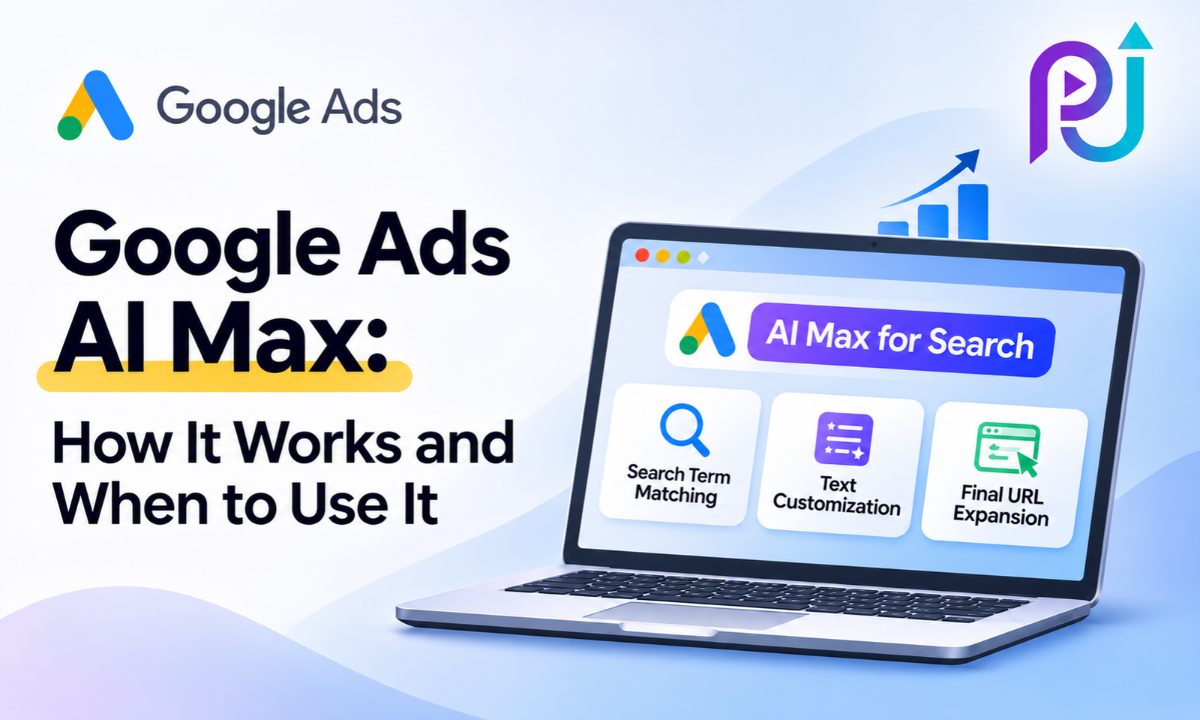
Its main features are search term matching, text customization, and Final URL expansion.
| Feature | What It Does | Main Benefit |
|---|---|---|
| Search Term Matching | Expands eligible search queries beyond existing keyword matching | Discover additional relevant searches |
| Text Customization | Creates advertising text using campaign and website information | Improve message relevance |
| Final URL Expansion | Selects relevant landing pages from your domain | Better match the visitor's search intent |
| Brand Controls | Includes or excludes specified brand associations | Manage brand-related traffic |
| Locations of Interest | Uses geographic intent at the ad group level | Reach searches related to specific locations |
| URL Controls | Includes or excludes selected pages | Manage landing page selection |
| Enhanced Reporting | Shows AI Max contributions and matching information | Review results and search relevance |
These features do not guarantee more conversions.
Their effectiveness depends on campaign quality, conversion data, bidding, competition, and the business's website.
1. AI Max Search Term Matching
Search term matching is one of the most important features of AI Max.
Traditional Search campaigns use the keywords and match types selected by the advertiser.
Google's matching systems already consider meaning and intent, particularly with broad match.
AI Max extends this approach by combining broad match technology with keywordless matching.
Instead of relying only on the advertiser's keyword list, Google can also evaluate relevant information from advertising assets and landing pages.
Example of AI Max Search Term Matching
Imagine a marketing agency targeting:
"Google Ads Management Services"
Its website also explains Google Ads account audits, conversion tracking, and campaign optimization.
AI Max may find relevant searches that are not explicitly represented in the original keyword list.
For example:
"Help Managing Google Search Campaigns"
"PPC Consultant for Lead Generation"
"Google Ads Specialist for Small Business"
These are illustrative possibilities, not guaranteed matches.
AI Max evaluates relevance using the available campaign signals.
Does AI Max Replace Keywords?
No.
Advertisers can continue using keywords and match types within their Search campaigns.
AI Max introduces additional matching opportunities.
It does not remove the need for a clear keyword strategy.
You should continue reviewing search terms and using suitable exclusions.
If your campaign starts matching searches that do not represent potential customers, investigate those patterns before increasing your budget.
Can You Turn Off Search Term Matching?
Yes.
Search term matching is enabled by default when AI Max is activated, but it can be controlled at the ad group level.
This can be useful when certain ad groups require more precise targeting than others.
2. AI Max Text Customization
Text customization helps Google create advertising headlines and descriptions that match relevant searches.
The feature was previously known as automatically created assets.
It uses information such as existing advertisements, keywords, landing page content, and your website domain.
How Text Customization Works
Imagine a business selling inventory management software.
Its existing advertisement focuses on inventory tracking.
Someone searches for software that helps manage inventory across multiple warehouses.
Google may create relevant advertising text that emphasizes the warehouse-related information available on the business's website.
This can help connect the advertisement's message with the searcher's needs.
What Are the Benefits?
Text customization can reduce the need to write every possible advertisement variation manually.
It may also help advertisers communicate relevant product or service details to different searchers.
However, automatically generated text should still be reviewed.
For example, a healthcare provider, financial services company, or regulated business may have strict requirements about promotional claims.
Advertisers should confirm that their website content is accurate and their campaign settings support appropriate messaging.
If your website contains outdated offers or unclear service descriptions, automatically generated advertising text may reflect those problems.
AI-generated advertising content is only as useful as the information and controls supporting it.
3. AI Max Final URL Expansion
Final URL expansion allows Google to select a relevant landing page from your website rather than always sending visitors to the exact URL specified in an advertisement.
The objective is to connect the user's search with a page that better matches their requirements.
Example of Final URL Expansion
Imagine an HVAC company offering several services:
- Air Conditioning Installation
- Furnace Repair
- Heat Pump Installation
- Emergency HVAC Services
Its advertisement normally directs visitors to the main HVAC service page.
A customer searches for "emergency furnace repair."
With Final URL expansion enabled, Google may choose the dedicated furnace repair page if it is relevant and eligible.
That page could provide more useful information than the general services page.
However, sending users to a different page is not always desirable.
A business may have pages that are not designed to generate inquiries.
Examples include careers pages, outdated promotions, legal pages, or support content.
How to Control Landing Page Selection
AI Max supports URL exclusions at the campaign level and URL inclusions at the ad group level.
These controls help guide the system toward appropriate pages.
Final URL expansion also requires text customization to be enabled.
One important limitation is that pinned responsive search ad assets may not be respected when Final URL expansion selects a different page.
Businesses that require exact advertising messages should review this behavior before activation.
For organizations using dedicated campaign landing pages, professional Landing Page Development can help make the destination more relevant to the customer's needs.
Google Ads AI Max vs Performance Max
AI Max and Performance Max both use Google AI, but they serve different campaign purposes.
This distinction is important because the two names can sound similar.
| Feature | AI Max for Search | Performance Max |
|---|---|---|
| Campaign Type | Feature suite within Search campaigns | Separate campaign type |
| Primary Inventory | Search text advertising | Multiple Google advertising channels |
| Existing Keyword Structure | Retained | Does not use regular Search keyword targeting |
| Search Term Expansion | Broad match and keywordless matching | Automated targeting and search themes |
| Ad Format | Search ads | Multiple asset formats |
| Landing Page Automation | Optional Final URL expansion | Available through relevant PMax settings |
| Search Term Reporting | AI Max matching and source information | PMax search term reporting and insights |
| Main Use Case | Expand and customize Search advertising | Find conversions across Google's channels |
Which One Should You Use?
Consider AI Max when you have an established Search campaign and want to explore relevant queries beyond your current keyword coverage.
Consider Performance Max when your advertising strategy benefits from reaching potential customers across multiple eligible Google channels.
For an eCommerce business, Performance Max may also support Shopping inventory through an appropriate product feed.
Neither option is automatically better.
The decision depends on your business model, campaign goals, conversion measurement, and available budget.
Both can be part of the same advertising strategy, but their performance should be evaluated carefully.
Google Ads AI Max vs Broad Match
Broad match and AI Max both help advertisers reach searches beyond exact keyword wording.
However, they are not identical.
Broad match starts with advertiser-provided keywords and uses Google's matching systems to identify relevant queries.
AI Max search term matching can also use keywordless technology informed by campaign assets and landing page information.
AI Max additionally offers text customization, Final URL expansion, and reporting features.
A business already using broad match with Smart Bidding may have less incremental query expansion available than one relying primarily on exact and phrase match.
However, the actual difference depends on the campaign.
The best way to understand the incremental value is through a controlled test.
Benefits of Google Ads AI Max
1. Discover Additional Relevant Searches
AI Max may identify search queries that advertisers have not added to their keyword lists.
This can help campaigns find additional customer demand.
2. Customize Advertising Messages
Text customization can help align ad copy with specific searches and landing page content.
3. Improve Landing Page Relevance
Final URL expansion can connect visitors with pages that better address their requirements.
4. Maintain Useful Campaign Controls
Advertisers can still use negative keywords, brand controls, and supported URL settings.
5. Access More Detailed Reporting
Google provides reporting fields that help advertisers investigate AI Max search term matching and asset performance.
These features can make campaign optimization more informed.
However, they do not replace the need to review actual business results.
What Are the Risks of Google Ads AI Max?
Irrelevant Search Traffic
Expanded matching can introduce searches that are not valuable to your business.
For example, a company selling business software may receive interest from people searching for free tutorials.
These visitors may not be suitable customers.
Increased Advertising Spend
AI Max may create additional opportunities for traffic.
However, more clicks and conversions do not automatically mean better profitability.
Monitor spending alongside conversion quality and customer value.
Unexpected Advertising Messages
Text customization can create advertising copy that differs from the original message.
Advertisers should review generated assets for accuracy and compliance.
Incorrect Landing Page Selection
Final URL expansion may select pages that are relevant to a search but less effective at generating conversions.
Use URL controls where needed.
Weak Conversion Signals
If a campaign counts every form submission as a valuable conversion, AI Max may help attract more submissions without improving sales quality.
Accurate conversion measurement should come before expanded automation.
Your Conversion Tracking Services setup should measure meaningful business outcomes such as valid inquiries, bookings, qualified leads, and purchases.
When Should You Use Google Ads AI Max?
AI Max may be worth testing when your Search campaign already has a reliable foundation.
The following situations can make it a useful option.
Your Search Campaign Has Consistent Conversion Data
Automation benefits from meaningful conversion signals.
If your campaign generates genuine leads or sales and tracks them correctly, you have a clearer way to evaluate whether AI Max adds value.
Your Existing Keywords Have Limited Growth Opportunities
Some campaigns reach a point where adding more close keyword variations produces limited additional results.
AI Max may identify relevant searches beyond the current keyword list.
Your Website Has Relevant Service or Product Pages
A website with clear, detailed landing pages provides useful information for search term matching and text customization.
You Want to Test Broader Search Intent
AI Max may help advertisers explore how customers describe products and services using different language.
You Can Review Performance Regularly
AI Max still requires active management.
Businesses should review search terms, conversion quality, landing pages, and advertising messages.
AI Max is best treated as a tested extension of an existing Search strategy, not an automatic replacement for campaign management.
When Should You Avoid or Delay AI Max?
There are situations where enabling additional automation may create more problems than benefits.
Your Conversion Tracking Is Inaccurate
If Google Ads records duplicate conversions or counts low-value actions as leads, correct the measurement first.
Your Campaign Is Limited by Budget
Google states that AI Max may be less effective when campaigns are constrained by budget.
Expanding eligible searches does not solve a lack of available spending capacity.
You Need Strict Advertising Message Control
Businesses in regulated industries may need careful control over headlines, descriptions, and landing pages.
Review feature-level settings before enabling text customization or Final URL expansion.
Your Website Has Weak Landing Pages
If the website contains outdated service information or pages that do not convert, fix those problems before introducing automated URL selection.
Your Search Campaign Has Not Established a Baseline
A new campaign with limited performance data may be difficult to evaluate.
You can still consider AI Max, but you should avoid assuming that automation will compensate for poor targeting or unclear conversion goals.
How to Set Up Google Ads AI Max
AI Max can be activated from the settings of an eligible Search campaign.
The exact interface can vary as Google updates campaign settings.
Step 1: Open Google Ads
Sign in to your account and choose the Search campaign you want to review.
Step 2: Open Campaign Settings
Navigate to the campaign's settings and locate the AI Max section.
Step 3: Enable AI Max
Turn on the option to optimize the campaign with AI Max.
Step 4: Review Search Term Matching
Check whether search term matching should remain active across all relevant ad groups.
The ad group settings allow more specific control.
Step 5: Review Text Customization
Decide whether you want Google to generate advertising assets based on campaign and website content.
Step 6: Review Final URL Expansion
If you enable Final URL expansion, confirm that appropriate landing pages are eligible.
Remember that Final URL expansion depends on text customization.
Step 7: Add Relevant Controls
Review negative keywords, brand settings, locations of interest, and URL inclusions or exclusions.
Step 8: Check Your Bidding Strategy
Google recommends conversion-based Smart Bidding for AI Max features to work effectively.
Check that your campaign has suitable conversion goals.
Step 9: Test Before Expanding
Evaluate the change through a supported experiment where appropriate.
Do not assume an improvement simply because the feature is enabled.
How to Test AI Max Without Risking Your Existing Campaign Performance
One of the best ways to evaluate AI Max is to compare it with an appropriate control.
Google Ads offers experiment capabilities for testing eligible campaign features.
An experiment can help compare performance with AI Max enabled against a version without it.
Before starting, define your success metrics.
For lead-generation campaigns, consider:
- Qualified Leads
- Cost Per Qualified Lead
- Conversion Rate
- Cost Per Conversion
- Search Term Relevance
- Sales Opportunities
For eCommerce campaigns, review purchases, conversion value, ROAS, and profitability where that information is available.
Avoid judging the result after only a few clicks or conversions.
The evaluation period should account for conversion volume, reporting delays, and the business's typical sales cycle.
Not all campaign setups qualify for the same experiment options, so review Google's current eligibility requirements.
How to Measure Google Ads AI Max Performance
Turning on AI Max is only the beginning.
The next step is checking whether it produces useful results.
Search Terms Report
Review the searches that trigger your advertisements.
Google includes AI Max-related match type and source information to help explain certain expanded matches.
Focus on commercial relevance rather than search volume alone.
Asset Performance Report
Review automatically generated advertising assets.
Check whether the messaging matches your actual services and offers.
Landing Pages Report
Examine which landing pages receive traffic through automated URL selection.
Look for pages that attract meaningful conversions.
Conversion Quality
If your CRM identifies qualified leads or customers, compare those outcomes with the advertising data.
A campaign generating more form submissions but fewer genuine sales opportunities may not be improving business performance.
Cost and Conversion Value
Monitor total spend, CPA, conversion value, and ROAS as appropriate.
More conversions at a similar CPA can still involve greater total spending.
Measure whether the campaign produces enough business value to justify the cost.
Example: Testing AI Max for a B2B Service Business
Imagine a business intelligence consulting company running a Search campaign.
Its existing campaign targets relevant keywords associated with Power BI consulting and dashboard development.
It uses Maximize Conversions bidding and tracks completed consultation requests.
The business wants to discover additional relevant searches.
Before activating AI Max, the team reviews negative keywords, service pages, advertising messages, and conversion tracking.
It then sets up a controlled AI Max test.
After collecting adequate data, the team compares qualified consultation requests rather than judging the test only by form submissions.
For example, the AI Max variation may attract additional inquiries from businesses seeking custom analytics solutions.
However, the team may also discover less relevant searches involving software training or job opportunities.
Those findings help determine whether AI Max creates useful growth or simply increases traffic.
This example is hypothetical and does not represent a real client result.
The important lesson is to measure customer suitability, not just conversion counts.
Common Google Ads AI Max Mistakes to Avoid
Enabling Every Feature Without Reviewing the Settings
AI Max offers several forms of automation.
Understand what each feature changes before enabling it.
Ignoring Negative Keywords
Expanded search matching still requires relevance checks.
Review search terms and exclude clearly unsuitable queries.
Leaving Unwanted URLs Eligible
If your website contains pages that should not receive advertising traffic, review URL exclusions.
Trusting Every Generated Advertisement
Automatically generated assets should be checked for accurate claims and relevant messaging.
Optimizing Only for Form Submissions
For lead-generation businesses, conversion volume is not always an accurate measure of lead quality.
Where feasible, incorporate qualified lead outcomes.
Comparing Incompatible Reporting Periods
Account for conversion delays, campaign changes, attribution settings, and the duration of the test.
Assuming AI Max Guarantees Better Results
AI Max is a set of tools.
Its performance depends on the quality of your campaign and the way you manage it.
Google Ads AI Max and the Future of Search Advertising
AI Max reflects Google's continued move toward using automation to interpret search intent and adapt advertising messages.
Keyword targeting is still important, but advertisers now have additional tools to reach searches that may not closely match their original wording.
Google has also begun upgrading certain legacy Search campaign capabilities into AI Max.
According to Google's April 2026 announcement, updated in June 2026, upgrades for automatically created assets and the campaign-level broad match setting began in September 2026.
Google extended the start of the Dynamic Search Ads transition to February 2027.
Advertisers using these features should review their campaign settings and prepare for relevant changes.
The larger lesson is that Search advertising requires both automation and informed management.
Businesses still need relevant offers, accurate conversion tracking, useful landing pages, and clear advertising objectives.
Should Small Businesses Use Google Ads AI Max?
Small businesses can consider testing AI Max, but it should not be enabled solely because Google recommends it.
A local business with a limited budget and a narrow service area may need strict control over search relevance.
For example, a roofing contractor serving one city should not pay for unrelated roofing tutorials or searches from customers outside its service area.
On the other hand, a growing business with reliable conversion tracking and strong service pages may benefit from testing additional relevant searches.
The right decision depends on budget, customer demand, existing campaign performance, and how much additional traffic the business can handle.
AI Max can help expand opportunities, but it does not remove the need for a well-managed account.
When Should You Hire a Google Ads Specialist?
Professional support may be useful when a business wants to introduce AI Max but cannot confidently evaluate search term relevance, conversion quality, or campaign results.
A Google Ads specialist can review the existing campaign structure, conversion goals, bidding strategy, negative keywords, and landing pages.
They can also help plan and evaluate an appropriate experiment.
The purpose is not to turn on every new feature.
It is to determine which settings can improve the campaign's ability to generate valuable customer actions.
You can explore previous advertising and marketing work in Prem Jasuja's Portfolio.
Why Work With Prem Jasuja for Google Ads Optimization?
Prem Jasuja is a freelance digital marketing professional with experience managing Google Ads, Meta Ads, conversion tracking, and landing page optimization.
His work includes SaaS businesses, B2B companies, local service providers, and eCommerce brands.
Different businesses require different campaign strategies.
A SaaS company may prioritize trial registrations and paid subscriptions.
A local service business may focus on qualified phone calls and bookings.
An eCommerce store may measure purchases, conversion value, and return on advertising spend.
AI Max should be evaluated against those business objectives.
Prem's approach focuses on campaign structure, search intent, accurate measurement, and ongoing optimization rather than relying on automation alone.
Explore Google Ads Management Services to learn more.
Final Thoughts
Google Ads AI Max brings additional automation to Search campaigns through expanded search term matching, text customization, and Final URL expansion.
These features may help advertisers discover relevant searches, adapt advertising messages, and improve landing page relevance.
However, more automation does not automatically mean better advertising results.
Businesses need to consider the quality of their conversion tracking, website content, campaign budget, and search traffic.
AI Max may be worth testing when your Search campaigns are already generating meaningful results and you want to explore additional opportunities.
If your current campaigns struggle with inaccurate tracking, irrelevant searches, or weak landing pages, address those issues first.
Review the new features, apply suitable controls, test their effect, and measure results against real business outcomes.
The best Google Ads strategy is not the one using the most AI features. It is the one that generates the right customers at a sustainable cost.
Need Help Deciding Whether Google Ads AI Max Is Right for You?
If you are unsure whether AI Max will improve your existing Search campaigns, a structured review can help identify the potential benefits and risks.
Prem Jasuja provides support for Google Ads account reviews, Search campaign optimization, bidding strategies, and conversion tracking.
Explore Google Ads Management to learn more about improving campaign performance.
Frequently Asked Questions
What Is Google Ads AI Max?
Google Ads AI Max is a suite of AI-powered features within Search campaigns. It expands search term matching, customizes advertising text, and can select relevant landing pages to help advertisers reach additional potential customers.
Is Google Ads AI Max a Separate Campaign Type?
No. AI Max is a feature suite available within Google Search campaigns. It does not replace the Search campaign structure or turn the campaign into Performance Max.
How Does Google Ads AI Max Work?
AI Max uses existing keywords, advertising assets, and landing page information to identify relevant searches. It can also generate customized headlines and descriptions and select suitable landing pages through Final URL expansion.
What Is the Difference Between AI Max and Performance Max?
AI Max enhances Search campaigns, while Performance Max is a separate campaign type designed to serve advertisements across multiple eligible Google channels. AI Max retains the Search campaign's keyword and ad group structure.
Does Google Ads AI Max Replace Keywords?
No. Advertisers can continue using keywords and match types. AI Max adds search term matching capabilities that can identify relevant queries beyond existing keyword coverage.
Does AI Max Work With Smart Bidding?
Yes. Google recommends conversion-based Smart Bidding for AI Max features to work effectively. Campaigns should use relevant conversion goals and reliable measurement before introducing broader automation.
Can I Control Which Landing Pages AI Max Uses?
Yes. AI Max supports URL inclusions and exclusions. Advertisers can also disable Final URL expansion when they need greater control over landing page selection.
Is Google Ads AI Max Good for Small Businesses?
It can be useful when a small business has reliable conversion tracking, relevant landing pages, and enough budget to test additional search opportunities. Results depend on the business and campaign setup.
Can Google Ads AI Max Increase Conversions?
AI Max may help discover additional relevant queries and improve advertising relevance, which can contribute to conversions. However, results vary, and there is no guarantee of higher conversion volume or profitability.
Should I Enable Google Ads AI Max on Every Campaign?
Not automatically. Review campaign objectives, conversion tracking, budget limitations, advertising controls, and landing page quality. Test AI Max where it offers a realistic opportunity to improve business results.