
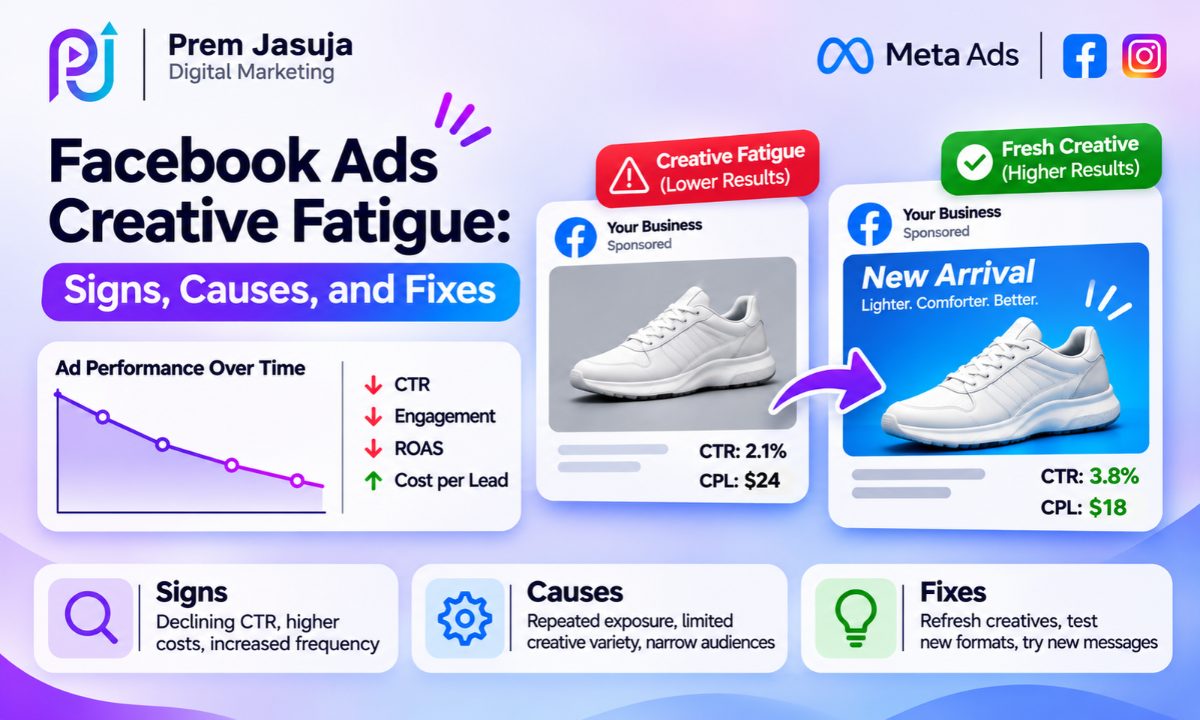
Your Facebook Ads campaign was performing well. People were clicking your advertisements, leads were coming in, and your cost per result was within budget.
Then something changed.
Your cost per lead started increasing. Click-through rates dropped, and the same advertisements stopped generating the results they once delivered.
You checked your targeting, budget, and campaign settings, but nothing obvious seemed wrong.
One possible explanation is Facebook Ads Creative Fatigue.
Creative fatigue happens when people repeatedly see the same advertising content and become less responsive to it.
However, not every performance decline means your creatives are tired.
Increased competition, landing page problems, weak offers, seasonal changes, and inaccurate conversion tracking can produce similar results.
Replacing a successful advertisement without identifying the actual cause can create unnecessary work and disrupt a campaign that may still have room to perform.
The best way to manage Facebook Ads Creative Fatigue is to identify real performance deterioration, understand its cause, and introduce relevant creative changes without unnecessarily replacing successful advertisements.
In this guide, you will learn what creative fatigue means, how Meta identifies it, which warning signs matter, and how to refresh campaigns without making random changes.
What Is Facebook Ads Creative Fatigue?
Facebook Ads Creative Fatigue occurs when repeated exposure to the same advertisement reduces how effectively it attracts attention, encourages engagement, or generates conversions.
An advertisement may perform well initially because its message, imagery, or video connects with the audience.
Over time, people may become familiar with it and stop responding.
For example, imagine a local roofing company promoting the same image advertisement to a limited geographic audience.
During the first few weeks, the advertisement generates inquiries at an acceptable cost.
As the audience sees it repeatedly, engagement may decline and cost per lead may increase.
This pattern could indicate Facebook Ads Creative Fatigue.
However, the age of the advertisement alone does not confirm the diagnosis.
Some advertisements remain effective for months. Others lose momentum much sooner.
The important question is whether performance has deteriorated because the audience is becoming less responsive to the creative.
Facebook Ads Creative Fatigue vs Audience Saturation
Facebook Ads Creative Fatigue and audience saturation are related, but they are not identical.
Creative fatigue occurs when a particular creative, message, or concept becomes less effective.
Audience saturation occurs when a campaign has reached much of the available responsive audience, making it harder to find new people who are likely to respond.
For example, if one advertisement performs poorly while other advertisements targeting a similar audience continue performing well, the issue may be specific to that creative.
However, if several different advertisements experience declining performance and reach growth slows, audience saturation may deserve investigation.
| Problem | Possible Warning Sign | Potential Response |
|---|---|---|
| Creative fatigue | One established ad loses effectiveness | Test a fresh execution or concept |
| Audience saturation | Reach growth slows across multiple ads | Review audience reach and targeting controls |
| Offer weakness | Multiple creatives struggle to convert | Review the offer and pricing |
| Landing page problem | Clicks remain healthy but conversions fall | Review the landing page |
| Tracking problem | Reported conversions change unexpectedly | Check Pixel, CAPI, and CRM data |
Identifying the right problem matters because introducing another advertisement may not solve a campaign-wide audience or conversion issue.
How Meta Identifies Facebook Ads Creative Fatigue
Meta provides creative fatigue recommendations for eligible advertisements in Meta Ads Manager.
According to Meta's Official Creative Fatigue Recommendations, the platform considers repeated exposure to an advertisement's image or video, including recent exposure from other campaigns associated with the same Page.
It also considers cost per result compared with advertisements previously run.
When eligible, advertisers may see two relevant delivery statuses.
Creative Limited
Meta may display Creative limited when an advertisement's cost per result is higher than comparable past advertisements but remains below twice that amount.
This suggests that creative performance may be becoming less efficient.
Creative Fatigue
Meta may display Creative fatigue when cost per result reaches at least twice the relevant comparison with previous advertisements.
This is a stronger platform-generated warning that repeated exposure may be affecting results.
These statuses have eligibility restrictions. They are not available across all campaign types and creative configurations.
Meta may also provide warnings before an eligible advertisement is published if it predicts fatigue during the first seven days.
Important: A Creative fatigue status is a diagnostic signal, not a reason to automatically pause every advertisement. Review actual performance and business outcomes before making changes.
7 Signs Your Facebook Ads Are Experiencing Creative Fatigue
1. Your Click-Through Rate Keeps Declining
Click-through rate measures the percentage of eligible impressions that result in clicks.
When people become less interested in an advertisement, its CTR may decline.
For example, an advertisement that initially generated a 2% link CTR may later average 1.2%.
That change deserves investigation, especially when the audience, placement mix, and offer remain comparable.
However, a declining CTR does not automatically prove fatigue.
Your advertisement may be reaching a different audience, experiencing new competition, or serving across different placements.
What to check: Compare link CTR against the advertisement's earlier performance and look for a sustained trend rather than a single poor day.
2. Your Ad Frequency Is Increasing
Frequency measures the average number of times an advertisement was shown to each person reached during the selected reporting period.
For example, a frequency of 3 means the advertisement was shown an average of three times per person reached.
Frequency can help identify repeated exposure.
However, there is no universal frequency threshold that confirms Facebook Ads Creative Fatigue.
A frequency of 4 may be acceptable for one campaign and excessive for another.
Retargeting campaigns often behave differently from broader prospecting campaigns.
What to check: Review frequency alongside CTR, cost per result, and reach over comparable periods.
Frequency becomes more meaningful when increasing exposure coincides with weaker performance.
3. Your Cost Per Lead or Purchase Is Increasing
A rising cost per result is one of the most important commercial warning signs.
Imagine a campaign that previously generated inquiries at $20 per lead.
Several weeks later, its average CPL reaches $35 while lead quality remains unchanged.
Facebook Ads Creative Fatigue may be contributing to that increase.
However, other factors such as auction competition, weaker landing page conversion rates, or targeting changes may also be responsible.
What to check: Compare CPM, link CTR, landing page conversion rate, and cost per result to understand where the additional cost originates.
Do not replace creative simply because CPA increased for one or two days.
4. Previously Successful Advertisements Stop Generating Results
Creative fatigue describes a decline from earlier performance.
An advertisement that never generated meaningful engagement or conversions may have a weak message or offer rather than fatigue.
Compare the current performance of established advertisements with their earlier results.
If one advertisement has declined while other creatives serving a similar purpose remain healthy, that difference provides a useful clue.
5. Engagement Declines Despite Similar Delivery
Repeated exposure can reduce audience attention.
You may notice fewer clicks, reactions, comments, or video interactions relative to impressions.
For video advertisements, review available watch and engagement metrics to understand whether people continue responding to the opening message.
However, engagement alone should not determine success.
A lead-generation advertisement with modest engagement may still generate qualified inquiries at an acceptable cost.
The objective is not engagement for its own sake. It is maintaining advertising effectiveness.
6. Your ROAS Declines While Advertising Conditions Remain Similar
For eCommerce campaigns, a decline in return on ad spend may suggest weaker creative response.
However, ROAS depends on more than advertising content.
Product prices, stock availability, checkout problems, promotions, and attribution changes can all affect reported revenue.
Before replacing an advertisement, confirm that the website and purchase tracking are functioning correctly.
Also review whether the decline affects one creative or multiple unrelated advertisements.
7. Meta Ads Manager Displays a Creative Fatigue Warning
For eligible advertisements, a Creative limited or Creative fatigue status offers a direct platform-generated signal.
Review the affected ad's recent performance.
Check whether the status aligns with rising frequency, weaker response, and higher acquisition costs.
Then determine whether introducing a different creative is likely to address the issue.
What Causes Facebook Ads Creative Fatigue?
Repeated Exposure to the Same Advertisement
When people repeatedly encounter the same image, video, or message, they may become less likely to notice or respond.
This can happen faster when the available audience is relatively small.
Limited Creative Variety
An account may contain several advertisements that look almost identical.
For example, changing only the headline color while keeping the same image, offer, and central message creates limited variety.
The audience may still experience those advertisements as repetitions of the same idea.
Narrow Audiences
Restricted geographic targeting, small retargeting pools, and unnecessary audience limitations can increase repeated exposure.
However, broadening an audience should not override genuine business requirements.
A local service provider should not advertise outside its actual service area simply to reduce frequency.
Budget Increases Without Reviewing Reach
Increasing spending can create more delivery opportunities, but it may also increase repeated exposure when the responsive audience is limited.
When scaling a successful campaign, review whether reach continues growing and whether acquisition efficiency remains acceptable.
Repetitive Advertising Messages
Facebook Ads Creative Fatigue is not always caused by showing exactly the same image.
Several different advertisements can communicate the same message using similar visual treatments.
For example, a SaaS company may run multiple advertisements that all focus on saving time.
Testing another customer benefit, such as reporting accuracy or collaboration, introduces a genuinely different reason to consider the product.
No Creative Testing Plan
Businesses sometimes wait until an advertisement performs poorly before producing a replacement.
This creates a gap between detecting fatigue and testing a new concept.
A regular creative review process helps prepare alternatives before they become necessary.
How to Check Facebook Ads Creative Fatigue in Meta Ads Manager
Follow this practical process before making changes.
Step 1: Open Meta Ads Manager
Select the relevant advertising account and campaign.
Step 2: Review the Delivery Column
Check for Creative limited or Creative fatigue statuses on eligible advertisements.
Remember that these labels are not available for every setup.
Step 3: Compare Performance Periods
Review current performance against an earlier period when the advertisement was running under comparable conditions.
Step 4: Examine Important Metrics
| Metric | Why It Matters |
|---|---|
| Frequency | Shows average repeated exposure |
| Link CTR | Measures response to the advertisement |
| CPM | Helps assess impression costs |
| CPC | Shows click acquisition costs |
| Cost Per Result | Measures efficiency against the selected goal |
| Reach | Helps assess how widely the ad is delivered |
| Conversion Rate | Indicates whether clicks produce the desired action |
| ROAS | Helps assess attributed revenue performance |
Step 5: Review Individual Ads
Do not rely only on campaign-level averages.
One declining advertisement may be hidden by stronger performance from other creatives.
Step 6: Check for Other Causes
Review recent budget changes, targeting settings, website functionality, and conversion measurement.
If reported leads or purchases change unexpectedly, examine whether your events fire correctly and whether duplicate browser and server events are being handled appropriately.
A structured Conversion Tracking Review can help identify measurement problems before you attribute the decline to advertising creatives.
Step 7: Decide What to Test
Identify whether the problem appears related to one asset, a repetitive concept, or a broader campaign condition.
How to Fix Facebook Ads Creative Fatigue
1. Create a Materially Different Advertisement
Meta recommends introducing new images or videos that are meaningfully different from the existing creative.
For example, instead of changing only the background color of a product advertisement, test a new approach.
A skincare brand might compare a product demonstration with a genuine customer experience.
A local service company could compare a completed-project photograph with a short explanation of its service process.
The objective is to give potential customers a new reason to pay attention.
2. Refresh the Opening Hook
For video advertisements, the opening moments help determine whether someone continues watching.
Review whether the existing hook communicates a clear problem, benefit, or reason to watch.
Test a new opening that addresses a different customer concern.
For example:
Original: "Looking for Better Business Reporting?"
Alternative: "Still Spending Hours Preparing Monthly Reports?"
These messages approach the same general service from different angles.
Avoid changing multiple elements without a clear testing objective when you need to identify what caused a performance difference.
3. Test Different Creative Formats
Different formats can help present products and services in new ways.
Depending on campaign requirements, consider testing static images, videos, carousels, product demonstrations, and authentic customer testimonials.
A single-image advertisement may explain a service clearly.
A short video may be better suited to demonstrating a process.
A carousel may help communicate multiple relevant product features.
Use the format that helps the audience understand the offer.
Do not assume video will automatically outperform static images.
4. Explore New Customer Motivations
Changing creative format is useful, but changing the underlying message can be more important.
For example, a business selling accounting software might test three distinct concepts:
- Save time on monthly reporting.
- Reduce manual data entry.
- Improve visibility into business finances.
Each advertisement addresses a different customer concern.
This gives the campaign a broader set of messages to evaluate.
5. Review Audience Size and Targeting
If repeated exposure appears related to limited audience reach, review your targeting settings.
Meta may recommend expanding your audience when appropriate.
However, audience expansion should remain consistent with your customer profile, service area, and campaign objective.
Check whether unnecessary restrictions are limiting delivery.
Do not assume every campaign needs broader targeting.
For a specialized B2B service, reaching the right people matters more than maximizing audience size.
6. Test Meta Advantage+ Creative Where Available
Meta Advantage+ creative can create variations from eligible advertising assets and tailor presentation based on available platform features.
This may help provide different creative experiences without manually producing every variation.
However, availability varies by campaign configuration.
Automated variations do not remove the need for strong original messaging.
If the underlying idea is weak or repetitive, automation alone may not address the problem.
7. Keep Winning Advertisements Active When Appropriate
One common mistake is immediately pausing an established advertisement when performance begins to fluctuate.
If the advertisement still generates profitable sales or qualified inquiries, replacing it may be unnecessary.
Meta also notes that retaining the original advertisement while adding a materially different one may help maximize results.
A practical approach is to introduce a challenger creative, review performance, and make decisions using adequate data.
If an advertisement continues meeting your business goals, do not change it simply because it has been running for several weeks.
Creative Iteration vs Creative Diversification
There are two different ways to refresh advertising content.
Creative iteration improves the execution of an existing idea.
Examples include testing a new hook, video length, image, or headline.
Creative diversification introduces a different concept, benefit, customer motivation, or persuasion approach.
| Situation | Recommended Approach |
|---|---|
| One video loses engagement | Test a new opening or execution |
| The central message still generates conversions | Iterate carefully |
| Multiple ads repeat the same message | Introduce a new concept |
| Several different concepts decline together | Investigate audience, offer, tracking, and market conditions |
| A successful ad still meets targets | Maintain and monitor it |
Both approaches can be useful.
The right decision depends on what your campaign data reveals.
How Often Should You Refresh Facebook Ads Creatives?
There is no universal requirement to replace Facebook or Instagram advertisements every seven, fourteen, or thirty days.
Creative performance depends on audience size, campaign spending, product demand, customer behavior, placement, and advertising format.
For example, a small local retargeting campaign may experience repeated exposure sooner than a campaign serving a large national audience.
However, even a high-frequency advertisement can remain effective if its audience continues responding.
Instead of following an arbitrary calendar, review performance regularly and prepare new creative concepts when meaningful signs of deterioration appear.
For advertisers with consistent spending, a weekly creative review can be useful.
That does not mean every advertisement needs weekly replacement.
Example: Diagnosing Facebook Ads Creative Fatigue in a Lead Campaign
Consider a hypothetical local service business running Facebook lead-generation advertisements.
The business notices these changes over comparable reporting periods.
| Metric | Earlier Period | Recent Period |
|---|---|---|
| Frequency | 1.8 | 3.7 |
| Link CTR | 2.1% | 1.2% |
| Cost Per Lead | $24 | $39 |
| Qualified Lead Rate | 55% | 54% |
These figures are illustrative and do not represent an actual client campaign.
The pattern suggests a reason to investigate possible creative fatigue.
Frequency increased, link CTR declined, and acquisition costs rose.
However, the business should first check whether CPM, budget, targeting, landing page performance, or competition changed.
If those factors remain comparable and the decline is concentrated in one established advertisement, testing a genuinely different creative would be reasonable.
The business does not necessarily need to rebuild the entire campaign.
How to Prevent Creative Fatigue in Meta Ads
A practical prevention strategy combines ongoing performance reviews with a reliable creative testing process.
Maintain a collection of potential advertising concepts based on customer questions, product benefits, objections, and genuine customer experiences.
Review existing ads by their message and format, not simply by the number of creative files.
Document what each creative is designed to communicate.
For example, a SaaS company might maintain concepts focused on efficiency, reliability, implementation, and customer support.
When one concept loses effectiveness, the team can test a different approach.
Prepare new creative ideas while established advertisements are still performing.
This reduces the need for rushed changes.
Most importantly, monitor actual business outcomes.
An advertisement with a slightly lower CTR may still generate customers at an acceptable acquisition cost.
Creative performance should support business results, not just engagement metrics.
Facebook Ads Creative Fatigue Checklist
Before replacing an advertisement, review these questions:
- Has the advertisement shown a sustained performance decline?
- Is frequency increasing over comparable periods?
- Has link CTR or another relevant response metric declined?
- Is cost per lead or purchase increasing?
- Does the decline affect one creative or several?
- Have budget or targeting settings changed?
- Are the offer and landing page still functioning correctly?
- Is conversion tracking accurate?
- Are the proposed replacement creatives meaningfully different?
- Can the current winning ad remain active during testing?
- Are creative decisions based on qualified leads, sales, or other relevant business outcomes?
A checklist helps organize the review, but no single answer confirms fatigue.
When Should You Request a Professional Meta Ads Audit?
Facebook Ads Creative Fatigue becomes more difficult to diagnose when an account contains many advertisements, overlapping messages, different audiences, or unreliable conversion tracking.
A structured account review can help determine whether declining performance comes from creative repetition or another cause.
A professional audit should review individual advertisement performance, campaign structure, audience delivery, conversion tracking, and landing page results.
It should also explain which changes deserve priority.
For example, if advertisements maintain healthy engagement but website conversions decline, the problem may occur after the click.
In that situation, reviewing your page's speed, messaging, forms, and mobile experience may be more useful than replacing the advertisements.
Learn how Landing Page Development and Optimization can support the customer journey after someone clicks an ad.
Businesses should avoid rebuilding successful campaigns simply because a performance metric has changed.
The better approach is to identify confirmed problems and develop a clear testing plan.
Why Work With Prem Jasuja for Meta Ads Optimization?
Prem Jasuja is a freelance digital marketing professional with experience in Facebook Ads, Instagram Ads, Google Ads, conversion tracking, and landing page optimization.
His work includes SaaS businesses, eCommerce stores, B2B companies, and local service providers.
Different business models require different creative strategies.
An eCommerce brand may prioritize product demonstrations, customer reviews, purchase costs, and ROAS.
A local service business may focus on location-specific messaging and qualified inquiries.
A B2B company may need advertising content that explains the service and addresses decision-maker concerns.
Prem's approach connects creative testing with campaign performance and meaningful conversion measurement.
You can explore his Portfolio and Previous Projects to learn more about the types of marketing work he has handled.
Final Thoughts
Facebook Ads Creative Fatigue is a common challenge for businesses running ongoing advertising campaigns.
As audiences repeatedly encounter the same images, videos, and messages, their response may weaken.
This can contribute to lower engagement, increasing acquisition costs, and reduced advertising efficiency.
However, declining results do not always mean your creative needs replacement.
Audience saturation, competition, landing page issues, and conversion tracking problems can create similar patterns.
The right approach is to compare advertisement performance over time, investigate alternative explanations, and test meaningful creative changes when the evidence supports them.
Sometimes a new hook is enough.
Other situations require a different creative concept or audience approach.
And when an advertisement continues generating valuable results, keeping it active may be the best decision.
Successful Meta Ads optimization is not about constantly replacing advertisements. It is about understanding what works, recognizing when performance changes, and making improvements based on evidence.
Need Help Fixing Facebook Ads Performance?
If your Facebook or Instagram advertisements are becoming more expensive or generating fewer qualified leads, a structured review can help identify the cause.
Prem Jasuja provides Meta Ads management, campaign analysis, creative testing, and conversion tracking support.
Explore Meta Ads Management Services to learn how professional campaign optimization can support your advertising goals.
Frequently Asked Questions
What Is Facebook Ads Creative Fatigue?
Facebook Ads Creative Fatigue occurs when repeated exposure to an advertisement reduces audience response. This may lead to lower engagement, fewer clicks, or higher costs per result. The diagnosis should consider performance trends and other campaign factors.
How Do I Know if My Facebook Ads Have Creative Fatigue?
Look for sustained declines in CTR or conversions alongside increasing frequency and cost per result. Meta may also display Creative limited or Creative fatigue delivery statuses for eligible advertisements. Review other possible causes before making changes.
What Causes Creative Fatigue in Meta Ads?
Common causes include repeated exposure, limited creative variety, narrow audiences, concentrated advertising spending, and repetitive messages. The rate of fatigue depends on the campaign and audience.
What Does Creative Limited Mean in Meta Ads Manager?
Creative limited is a delivery status Meta may show for eligible advertisements when cost per result is higher than comparable past advertisements but remains below twice that amount. It indicates that creative effectiveness may need attention.
What Does Creative Fatigue Mean in Meta Ads Manager?
Meta may display Creative fatigue for eligible advertisements when cost per result reaches at least twice the relevant historical comparison. The label reflects Meta's assessment of repeated creative exposure and performance.
What Frequency Causes Facebook Ad Fatigue?
There is no universal frequency threshold that proves creative fatigue. The appropriate frequency depends on audience size, campaign objective, placement, and customer behavior. Review frequency alongside engagement and conversion trends.
How Often Should I Change Facebook Ads Creatives?
Change creatives when performance evidence supports doing so rather than following a fixed schedule. Regular reviews are useful, but successful advertisements do not need replacement solely because they have been active for several weeks.
Should I Pause an Advertisement Showing Creative Fatigue?
Not automatically. Review cost per result, qualified leads, ROAS, and the campaign's broader performance. Testing a new creative while retaining an effective existing ad may be appropriate.
Can Meta Advantage+ Creative Help With Creative Fatigue?
Meta Advantage+ creative can generate variations for eligible campaigns and may help diversify how advertisements appear. However, it does not replace the need for relevant messaging, strong original content, and performance analysis.
Can Creative Fatigue Increase Facebook Ads Cost Per Lead?
Yes. If an advertisement becomes less effective at attracting relevant responses, cost per lead may increase. However, higher CPL can also result from competition, targeting changes, website problems, or inaccurate tracking. Investigate the cause before changing creatives.